
Historical article
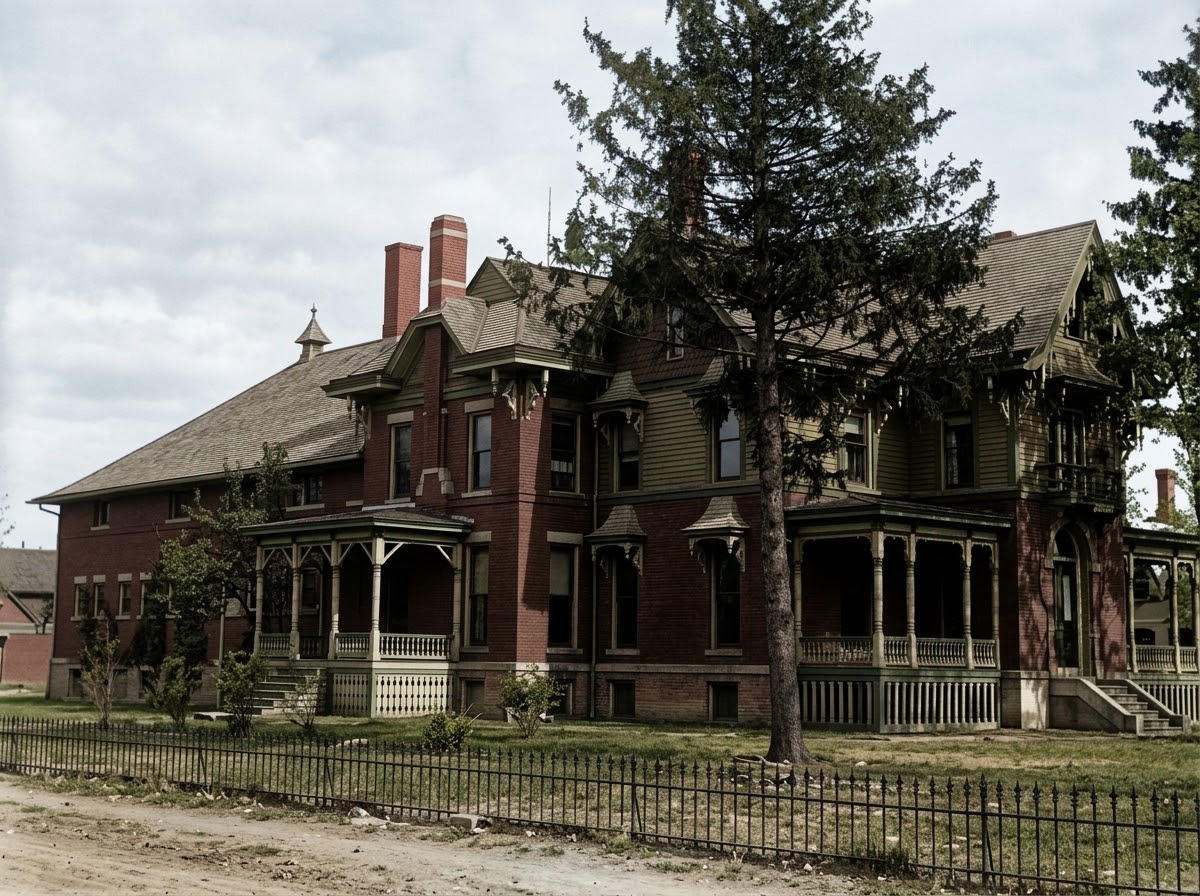
Bellevue YMCA - Originally Henry Flagler's home and then Daniel Harkness residence
November 13, 2026
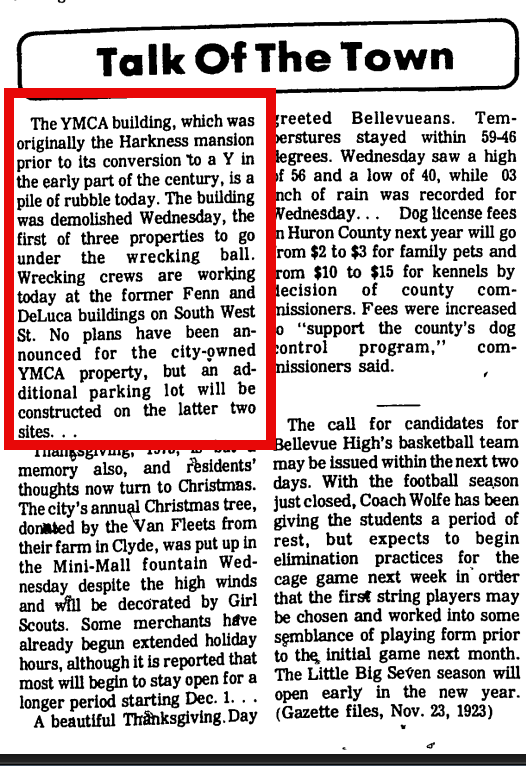
By Don C. Schueler14 min readLate Industrial Era · 1900sI first learned about the Flagler and Harkness families at the YMCA in Bellevue. The property was originally Henry Flagler’s home, which he built in Bellevue. After Flagler moved on, Daniel M. Harkness purchased it. Following Daniel’s death, Daniel's son William L. Harkness donated the property to the YMCA. This 1907 newspaper article outlines the evolution of the building and its importance to the community. Unfortunately the city decided to raze it in 1973. One can only imagine, given the notoriety of Standard Oil, Flagler and Harkness, what the benefit to the town could have been through the years if it had been kept.
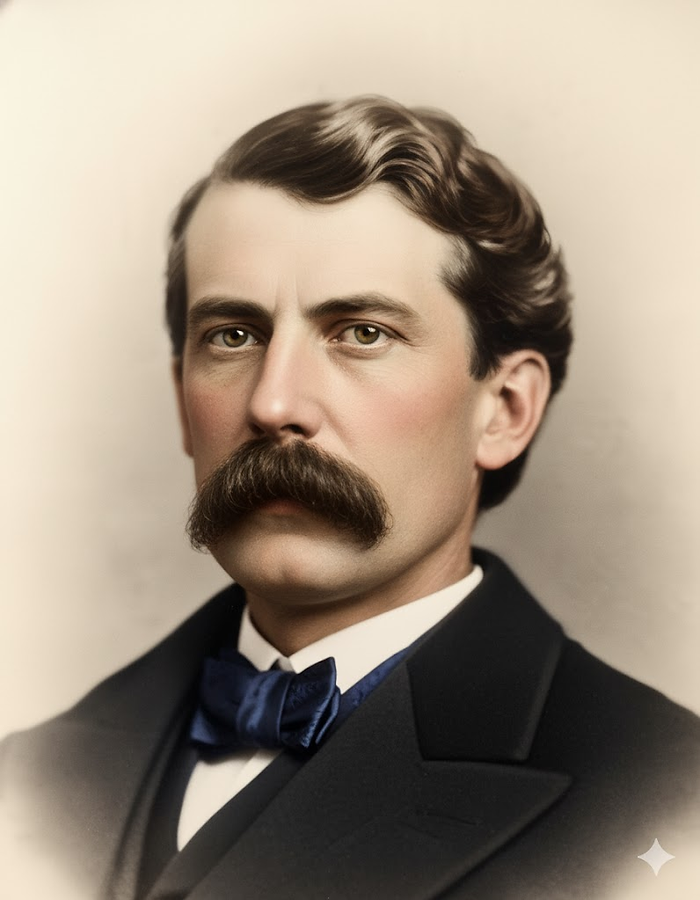
Henry M. Flagler
Click to see how they were all related! Henry Morrison Flagler (January 2, 1830 – May 20, 1913) was an American industrialist and a founder of Standard Oil, which was first based in Ohio.
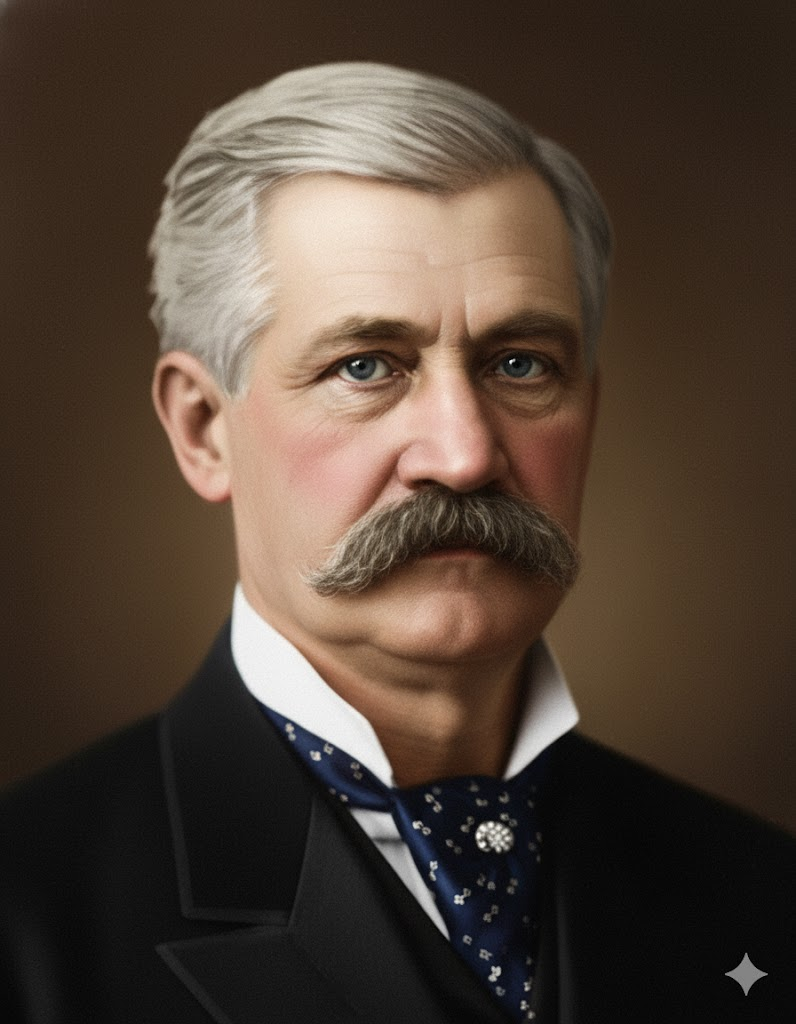
Daniel M. Harkness
Daniel M. Harkness – Henry Flagler’s half-brother Detailed life events Born September 26, 1822 in Milan, Ohio Died August 5, 1896 (age 74) in Bellevue, Ohio Resting place Bellevue Cemetery, Bellevue, Ohio Spouse Isabella Harkness Children 5 children: 3 died in childbirth; daughter Katie died at the age of 8, and son William L.
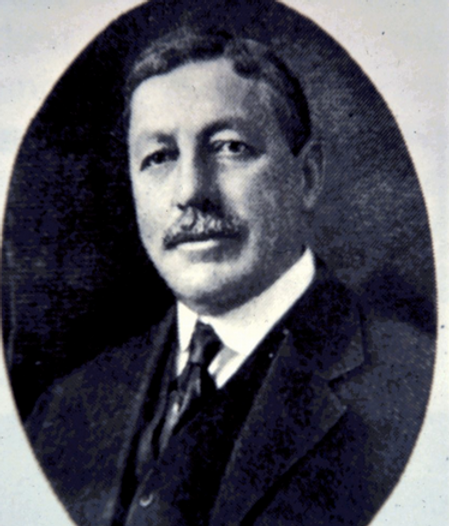
William Lamon Harkness
Detailed Life Events Born August 8, 1858, in Bellevue, Ohio Died May 10, 1919 (aged 60) New Hyde Park, New York Resting place Woodlawn Cemetery Education Yale University (Class of 1881) Spouse Edith Hale Children Louise Hale Harkness (1898-1978), William Hale Harkness (1900–1954) Parent(s) Daniel M.

YOUNG MEN'S CHRISTIAN ASSOCIATION OF BELLEVUE
The Bellevue Railroad and City Y. M. C. A.
The Bellevue Gazette — December 16, 1907 (Section 9, Page 37)Page 1 of 8
I. Civic Ideals and the Founding Movement
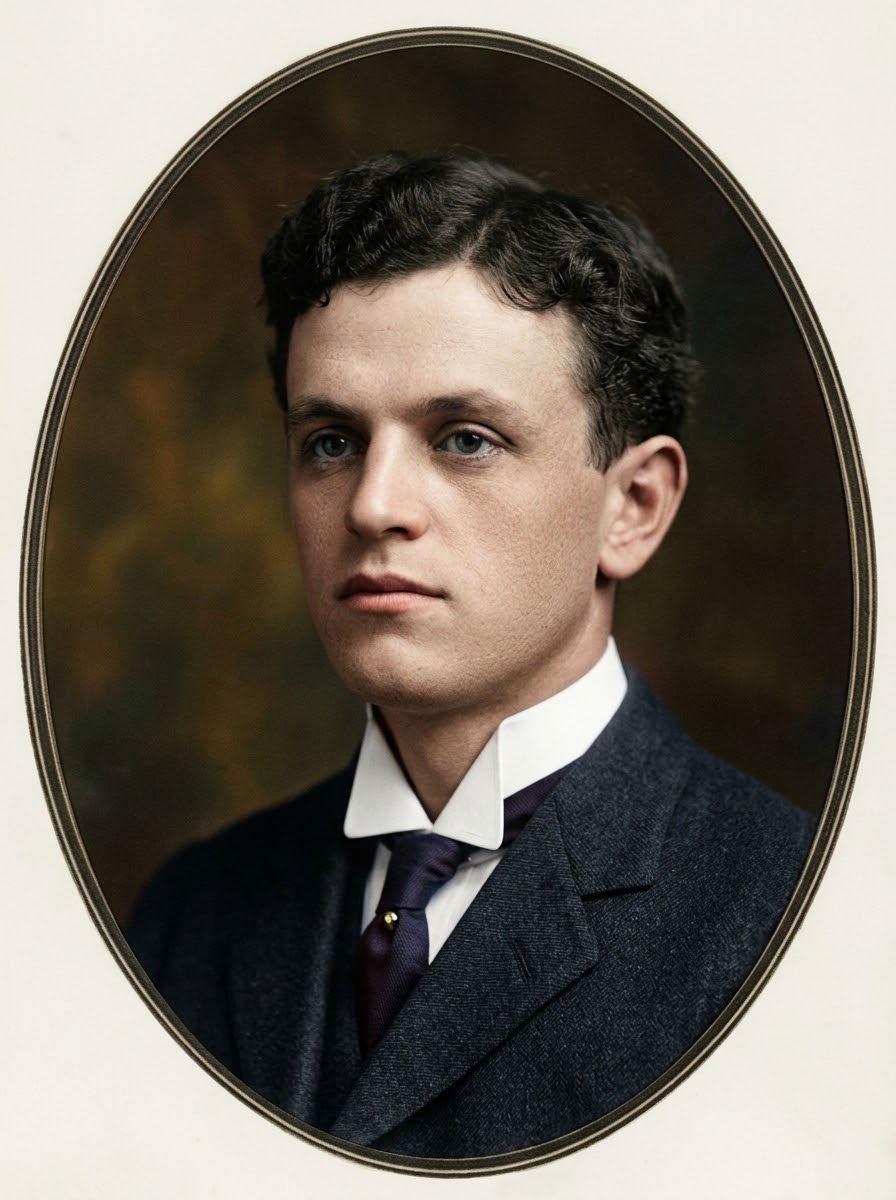
J. P. Martin — General Secretary Y. M. C. A.
ONE of the very best evidences of the real progress of a community is found in the interest that community takes in its morals. The most valuable asset of a state is not property, but men of high ideals. Many nations once powerful and wealthy have gone into decay because the manhood of that nation was not clean. Material prosperity is not always an index of progress, for if material prosperity is won at the expense of manhood it is bound to eventually result in ruin.
Bellevue has given attention in its development to more than the building up of splendid industrial institutions and material business, but has also made provision to preserve and encourage the qualities of citizenship in its boys and young men which would build a good town in time even under adverse surroundings. A bad man will fail in good surroundings, while a good man will often succeed amid environments which are discouraging to many. Many of these facts had been clearly defined in the minds of some of our citizens prior to the year 1904. Several of the churches before that time felt the need of an effort being made to meet some of the conditions which were not being met, so that independently these churches were making definite plans to establish institutional features.
At about this same time Mr. C. B. Hoyt, who was at that time connected with the N. Y. C. & St. L. Ry. as chief supervisor of tracks, realized the need of some place of resort possessing homelike conveniences for railroad men, and within a very short time spoke to the officials of the company with regard to the same. The idea was favorably received, but no action was taken.
When the Congregational church people agitated the matter of purchasing the Harkness property, next to the church, for a parish house, the matter of doing something for the railroad men was brought before W. H. Canniff, President of the N. Y. C. & St. L. Ry. Mr. Canniff declined to have anything to do with it if the movement was to be under the control of a single church, and suggested broadening the idea, and organizing a Railroad and City Young Men's Christian Association. At Mr. Canniff's request, Mr. E. L. Hamilton, international railroad secretary, was called and an investigation of the field was made.
The Bellevue Gazette — December 16, 1907 (Section 9, Page 37)Page 2 of 8
II. Subscription Campaign and Dedication (1904)
The Welcoming Open Door
Upon Mr. Hamilton's report to Mr. Canniff regarding the possibilities of an association, Mr. Canniff agreed to give $7,500 toward the purchase of the property and the erection and equipment of the necessary addition to the building. He also agreed to contribute $75 per month toward operating expenses.
A mass meeting of Bellevue citizens was called, the proposition adopted, and committees appointed for purchase of property, solicitation of funds, and repairs and addition to building. In spite of the fact that Bellevue citizens had just subscribed about $6,000 toward the site for a Carnegie library, and Mr. H. C. Stahl, president of the Ohio Cultivator Co., had pledged $3,000 for books for the same, the start was made to raise $7,500 for the Y. M. C. A. Mr. W. L. Harkness, of Cleveland, whose early life had been spent in the home that was to be transformed into a Y. M. C. A. home, was made acquainted with the situation and promptly pledged one-half the amount, $3,750.
With this encouragement at the start, the soliciting committee began its work, having secured the assistance of Mr. M. E. Wright, formerly secretary at East Liverpool, Ohio, for the canvass. In about six weeks nearly $7,000 had been pledged, not including the R. R. Co.'s gift, nor the gift of Mr. Harkness. Of this $7,000 there was no single subscription over $100. Plans were immediately prepared and work begun, and on May 6, 1904, the building was dedicated and thrown open for use.
III. The Building, Furnishings, and Gymnasium
The General Secretary's Office
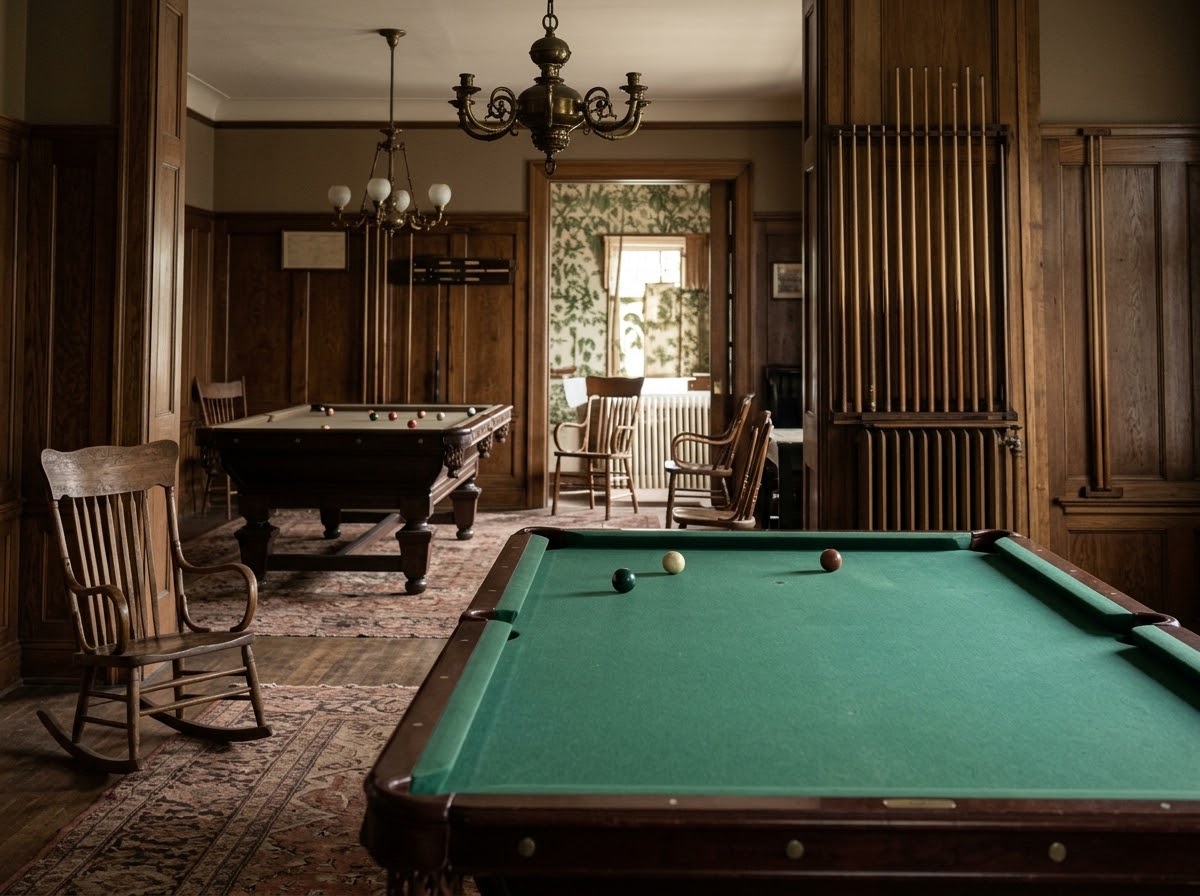
One of the Recreation Rooms
The Bellevue Gazette — December 16, 1907 (Section 9, Page 37)Page 3 of 8
The lot on which the building stands has a frontage of 145 feet, and a depth of 243 feet, giving ample room for tennis, croquet, and outdoor gymnastics. The main floor of the building contains the reading room, 16×20 feet, finished in cherry, and having a beautiful marble fireplace and mantle. Just back of this is the boys' room, 16×30, finished in mahogany, with a beautiful panelled wainscoting and fireplace and mantle, with large mirror over it. This was formerly Mr. Harkness' dining room. A steel ceiling was put in which was tinted a delicate robin's egg blue. The frieze is of a deeper blue with conventional design picked out in gold, with gilt moulding below. The paper is a rich dark blue, and the beautiful Brussels art square on the floor harmonizes perfectly with the walls and ceiling.
The furniture is of the mission style in Flemish oak, the special pieces being couch and Morris chair, upholstered in Spanish leather, easy chairs, library tables and book case. The entire expense of thus preparing and furnishing the boys' room was borne by Mr. and Mrs. Jesse Vickery, as a memorial to their boy, Gordon Henry Vickery, born December 7, 1893, died January 23, 1905, and the work received their personal supervision.
The other rooms on this floor are the large social room for men, containing easy chairs, game tables, piano, etc., and the coat room. The social room was made by cutting an arch, thus throwing two rooms into one. One of these rooms is finished in walnut, and the other in butternut, each containing a beautiful fireplace and mantle. They are papered alike, in a very appropriate manner.
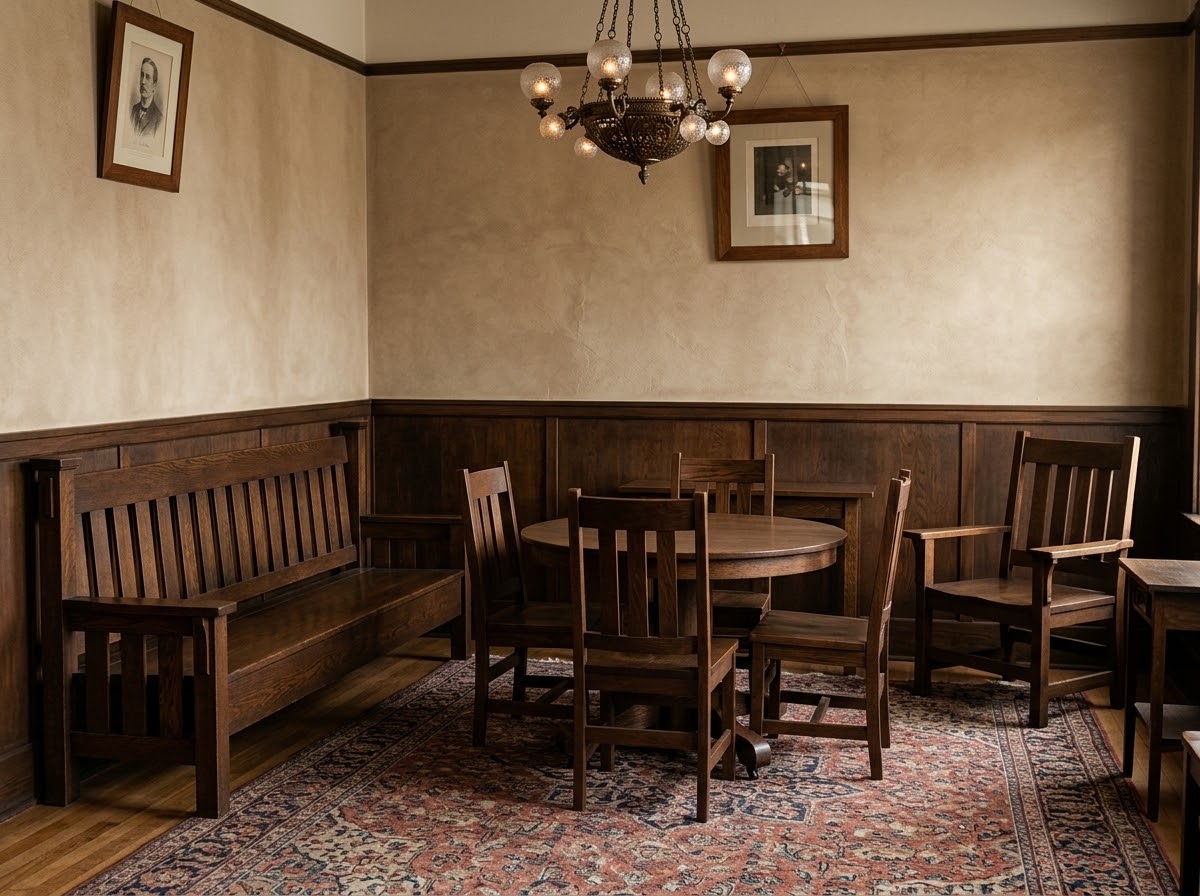
The Boys' Assembly Room
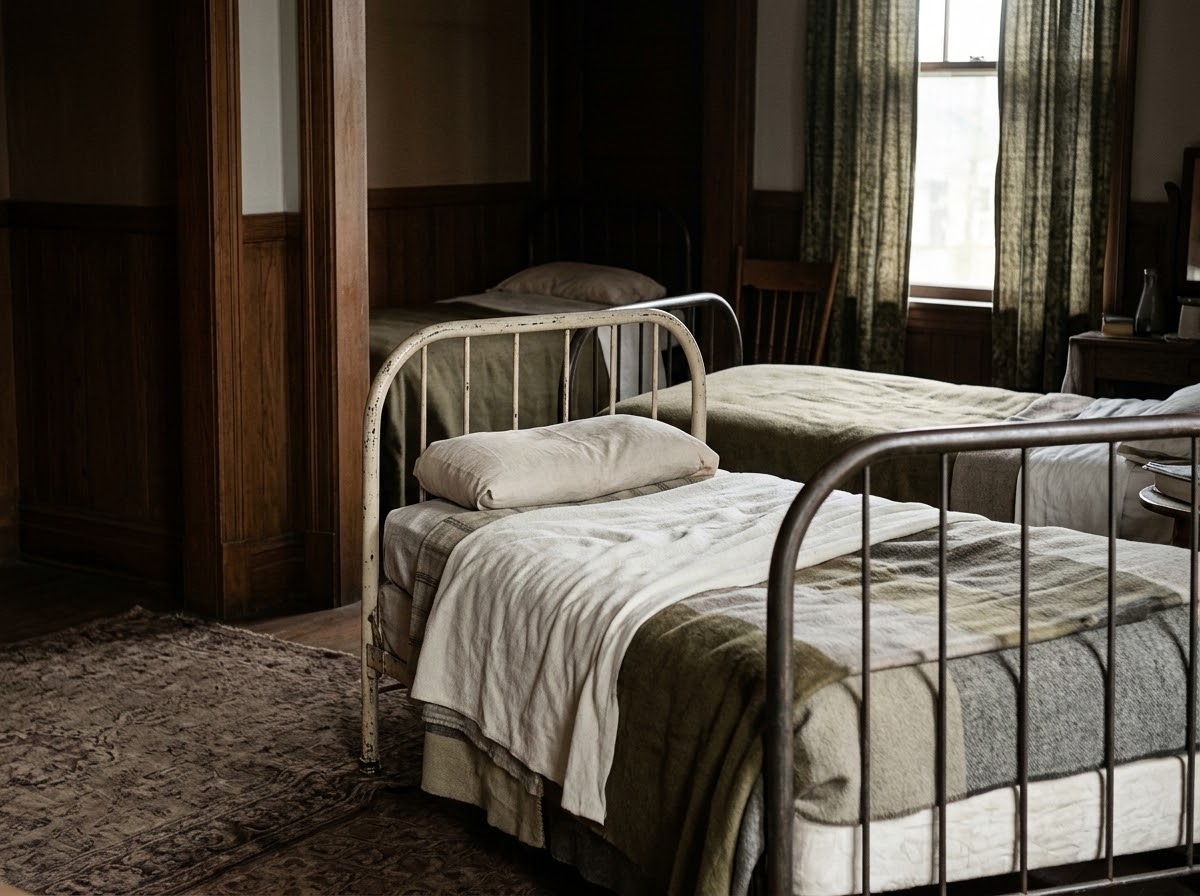
One of the Rest Rooms
The addition contains a fine gymnasium, 40 feet by 60 feet floor, 18 feet to trusses, with suspended running track, with space for physical director's office and visitors on the main floor, and another visitors' gallery above. The gymnasium equipment was donated by the Ohio Cultivator Co., at an expense of $500. It was purchased of the Narragansett Machine Co., which guarantees the quality. The physical director's office equipment, consisting of desk, scales, measuring instruments, etc., was donated by Mr. C. B. Hoyt, superintendent of track construction and maintenance, of the N. Y. C. & St. L. Ry. Co., who has been from the start an active worker.
The Bellevue Gazette — December 16, 1907 (Section 9, Page 37)Page 4 of 8
Two fine bowling alleys are in a building on the south side of the gymnasium, and they are in almost constant use. The basement contains the baths—three tub, four shower, and plunge fifty feet long and fifteen feet wide—wash stands, closets and lockers for seniors. The basement under the old part contains boys' locker room, heating plant, coal room, and two additional rooms used for club rooms. The attic of the old part is also used for club rooms. In the second story of the old part are six sleeping rooms, with twelve beds, which are in almost constant use. Also a fine large committee or class room, and a small room over the front vestibule for secretary's private office.
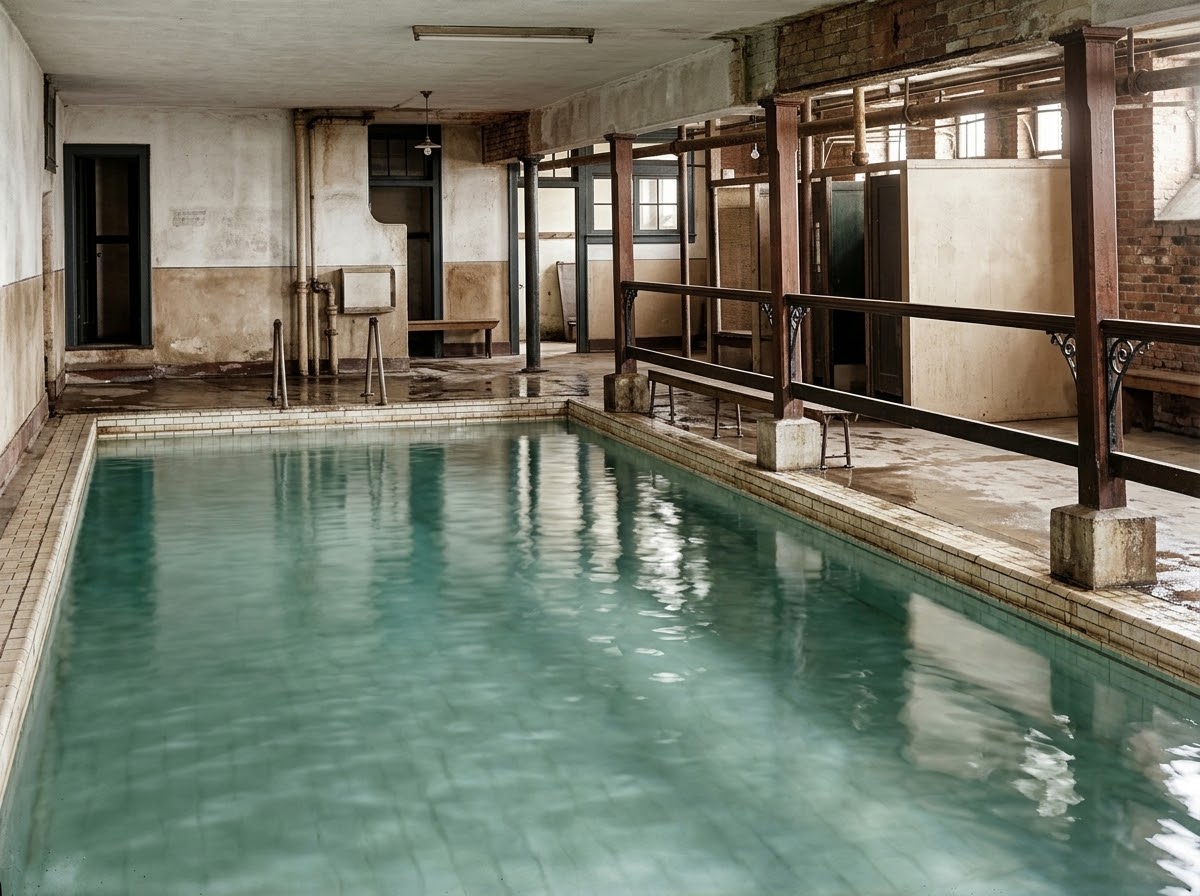
The New "Old Swimmin' Hole."
IV. Property Valuation and Room Donors
The actual cost of property, exclusive of equipment, is a trifle over $19,000. The value of the equipment is about $2,500, and with the exception of the boys' room, represents the effort of a Furnishing committee of ladies. Ten out of the twelve bedroom equipments were direct donations, it being understood at the time the money was subscribed that the donors should have credit for a rest room equipment. The secretary's private office on second floor was furnished by the Reformed Sunday school and Mrs. Nettie Smith. The bath room on the second floor was equipped with very ancient fixtures and the men in the Ohio Cultivator shops passed around a paper and collected enough money to put in a hard maple floor and fine up-to-date fixtures.
Donated Room / FacilityContributors & BenefactorsTen Rest Room EquipmentsCongregational Sunday School; Evangelical Sunday School; W. L. Gilmore (Supt. Motive Power, N. Y. C. & St. L. Ry.); Brotherhood of Locomotive Engineers; Auxiliary to B. of L. E.; Auxiliary to B. of R. T.; Brotherhood of Railway Trainmen; Eastern Star; J. K. Lindley, conductor; W. H. Gardner, merchant.
The Bellevue Gazette — December 16, 1907 (Section 9, Page 37)Page 5 of 8
Donated Room / FacilityContributors & BenefactorsBoys' Memorial RoomMr. and Mrs. Jesse Vickery (in memory of Gordon Henry Vickery, 1893–1905).Secretary's Private OfficeReformed Sunday School and Mrs. Nettie Smith.Second-Floor Bath RoomEmployees of the Ohio Cultivator shops (hard maple floor and up-to-date fixtures).Gymnasium & Office EquipmentOhio Cultivator Co. ($500 gymnasium apparatus); Mr. C. B. Hoyt (physical director's office desk, scales, and measuring instruments).
V. Governance, Committees, and Staff
The management of the association is vested in a board of directors, supported by standing committees and an executive staff:
Body / RoleOfficers and MembersBoard of DirectorsJesse Vickery, President; Geo. Shadle, Vice President; F. W. Schanck, Secretary; F. A. Knapp, Treasurer; D. J. Beck, Director; J. M. Smith, Director; Dr. J. C. Morrow, Director; J. A. Wright, Director; I. C. Brown, Director; W. A. Mason, Director; G. A. Watt, Director.Finance CommitteeG. A. Wright, chairman; J. H. Brinker; J. D. Cook.Auditing CommitteeM. F. Gross, chairman; L. P. Oehm; Calvin Friedley.Membership CommitteeA. G. Algier, chairman; G. F. Shadle; W. B. Snyder; G. R. Moore; A. A. Ruffing; Samuel Bergman.Social CommitteeG. A. Watt, chairman; Harry Karshner; Carl Zehner; Warren Van Buren; F. O. Bates.Physical CommitteeC. B. Hoyt, chairman; Chas. Woleslagel; Rev. G. L. Smith; T. C. McKeen; Hayes Wolf.
The first man called to the general secretaryship was Mr. G. E. Ingalls, formerly of Argentine, Kans. The first assistant and physical director was Mr. James L. Miller, of Cleveland. Mr. Ingalls resigned on December 1, 1906, and Mr. J. P. Martin, formerly of Columbus, was called. Mr. W. B. Rice, formerly one of the Grand Rapids, Mich., physical directors, has since succeeded Mr. Miller and is now in charge of the boys' and physical departments. W. C. Whitney and T. P. Standering are the janitors. The other employees are Earl Kegerreis, night office boy, and Harold Smith, head pin boy.
VI. Membership, Foundation, and Three-Year Record
The association in Bellevue is one of the largest and most prosperous to be found anywhere for the size of the town. On December 1, of this year, the official records showed a membership of 212 railroad men, 339 city men and 105 boys, making a total of 656 members.
The Bellevue Gazette — December 16, 1907 (Section 9, Page 37)Page 6 of 8
The association is distinctively a religious organization and is built on the following foundation, which is commonly known as the "Paris Basis":
"The Young Men's Christian Association seeks to unite those young men who, regarding Jesus Christ as their God and Saviour according to the Holy Scriptures, desire to be his disciples, in their doctrine and in their life and to associate their efforts for the extension of his kingdom among young men."
Around this main purpose are grouped a number of other departments not commonly known as the religious work department, which may be known as the physical, educational and social. The Bellevue association has been in operation three years, seven months and 10 days today. The building has not been closed during that entire time. A group of men and boys can be found there at almost any time.
Department / Activity MetricRecorded Attendance & UsageOfficial Membership (Dec. 1, 1907)656 total members (212 railroad men, 339 city men, 105 boys)Total Building VisitorsAbout 215,640 men and boys since dedicationDormitory & Baths10,324 men accommodated in dormitory; 66,827 baths givenGymnasium & BowlingOver 17,000 men and boys in gymnasium; 43,849 bowling games rolledSocial Functions10,031 persons at special social functions, plus summer lawn band concertsEducational LecturesOver 12,600 persons attending annual educational lecture courses
VII. Athletics, Social Life, and Educational Course
The Bellevue Gazette — December 16, 1907 (Section 9, Page 37)Page 7 of 8
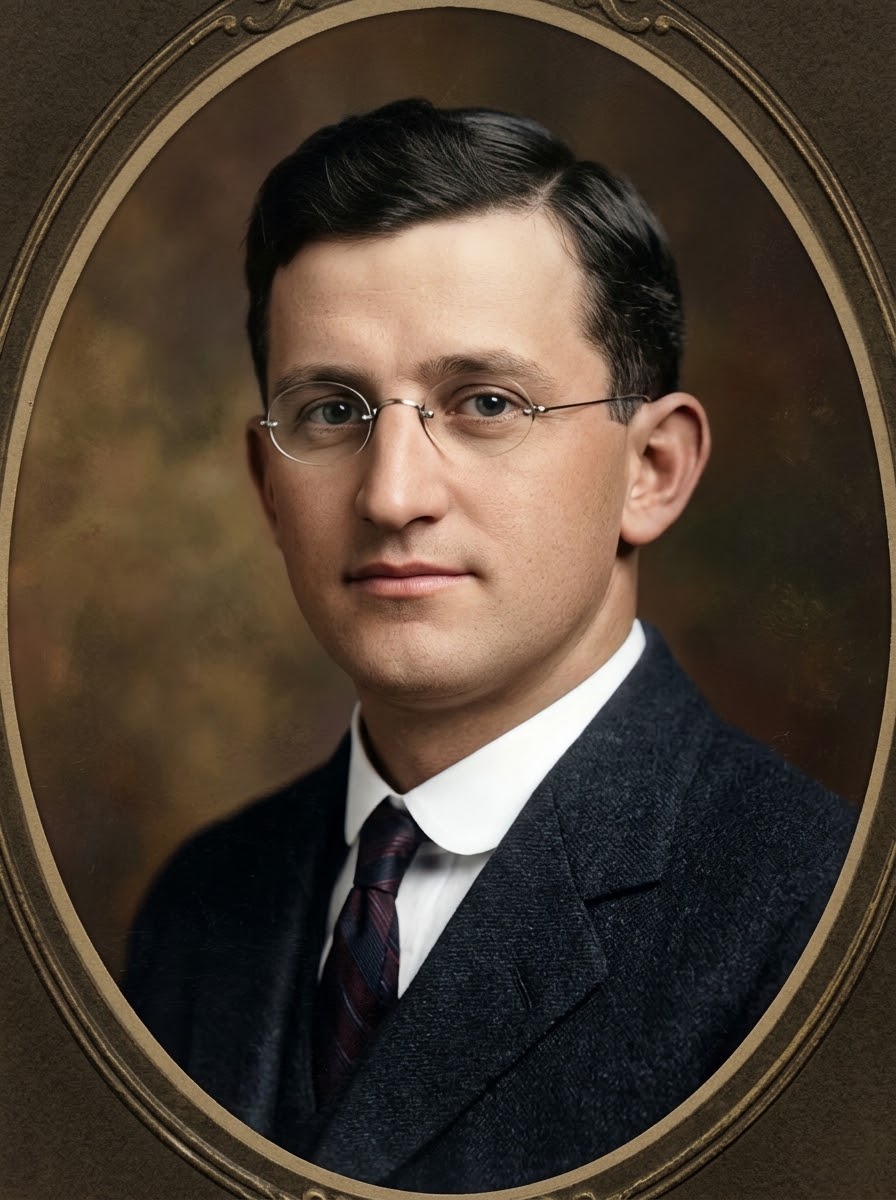
W. B. Rice — Physical Director Y. M. C. A.
A number of social events have been held. The social life of the association is a strong feature. The total attendance at special social functions held has been 10,031 persons. During the summer months band concerts and other special lawn features are conducted.
The physical department has been one of the very greatest attractions in the association. Regular and systematic instruction is given to develop the physical man of Bellevue. Over 17,000 men and boys have availed themselves of the gymnasium. The bowling alleys have been used for 43,849 games. A league of six teams is playing a regular schedule each year. The teams this year are composed of five members each and belong to the following teams: Rollers, Cubs, Diamonds, Buckeyes, Alcides and Nickel Plates. From ten to a dozen baseball teams play a regular schedule during the summer.
One of the departments which has been receiving considerable favor within the last year is the Educational department. Over 12,600 persons have attended various educational lectures. A lecture course is being conducted every year, this year having the following attractions: Frank Dixon, Lee Francis Lybarger and Maud Ballington Booth, as lecturers; The Lyric Glee Club, The Transcontinental Trio and Isabel Garghill Beecher, as entertainers, and a concert by the Schildkret Hungarian Orchestra. These seven numbers are sold to the people for $1.60 including reserved seats. The committee has this year also taken up the work of conducting regular classes for the instruction of men in various subjects. Two of these classes which are in regular session each week, are a class in bookkeeping and a class in mechanical draughting. A class in sign painting will be started February 1. The question of a school for foreigners and an agricultural school is before the committee and plans are under way to give this additional opportunity. The committee is composed of R. R. Parkhurst, chairman, J. A. Wright, E. F. Warner, J. E. Marvin and Joseph E. Wolf.
Another flourishing and commendable work is that for boys. A beautiful room has been fitted up for a boys' club by Mr. and Mrs. Jesse Vickery. The department has over one hundred boys. Gymnasium classes are held for both the Junior and Intermediate sections. Lectures upon educational topics are given, entertainments and socials are held. Cross country trips have become quite popular and is stimulating interest In developing physical endurance. Regular Sunday religious meetings and Bible classes are conducted in this department A group of boys attend the conference on boys' work each year at Lake Geneva, Wis., where the life purpose of many boys have been changed. This department is one of most effective and important in the association. The committee having the work in charge is Jesse Vickery, chairman, Rev. D. W. Loucks and C. R. Callaghan.
The defined religious activities are directed largely by a religious work committee made up of H. C. Bates, chairman, John Wise, R. A. Elder, F. W. Schanck and H. P. Schell. Regular meetings are held for men, where questions of common interest are discussed and upon which addresses are often given. Meetings in churches, union meetings of the Churches on the lawn during the summer months, Bible classes for men and boys, special efforts to stimulate Interest in Bible study and personal work are some of the things carried out in this department Since the inception of the work, about 8,444 men and boys have attended religious services of various kinds held under the auspices of the association. This figure does not include the ladies who attended.
Here's the original page from the Bellevue Gazette -