
Editorial charter
The Gilded Standard
Gilded Greats uses technology cautiously, keeping historical records at the center and drawing a clear line between documented evidence and imagined detail.
History, not historical-looking fiction
Spend five minutes exploring history on social media today and you will meet an avalanche of what can only be called AI slop: slick sixty-second clips of waxen-faced Morgans, Flaglers and Rockefellers in the wrong collars, drifting through dreamlike ballrooms to robotic narration—and sometimes even bearing the wrong faces.
Worse than the uncanny pictures are the fabrications. To keep viewers watching, content mills invent quotes that were never spoken, place people in rooms they never entered, and conjure scandals out of thin air. AI can make historical images and stories more vivid, but it can also blur the line between what the record shows and what a tool has imagined.
A generated face or a fabricated feud is not historical storytelling. It is fiction dressed in period clothing.
Real lives, real records
The Gilded Age was neither a fairy tale nor a cartoon. It was a dense, contradictory, human era of brilliant ambition, staggering wealth, family tragedy and world-shaping philanthropy. The people who laid railroads through swamps and endowed hospitals and universities were real, and they deserve to be remembered through the best evidence available.
Documents and historical sources remain the foundation of our stories. If an authentic portrait does not exist, we will never invent one. We can tell a person's story through letters, deeds, maps and cemetery records, but a generated image is not an authentic portrait, and an imagined scene is not proof that an event happened as depicted. That being said, we do use AI where needed to make the story more real to todays readers.
Where we use technology—and where we stop
We are not against technology. We use it as a magnifying glass for the archive, never as a replacement for it. We use some AI generation and visual treatments sparingly, with care for the distinction between documented history and reconstruction.
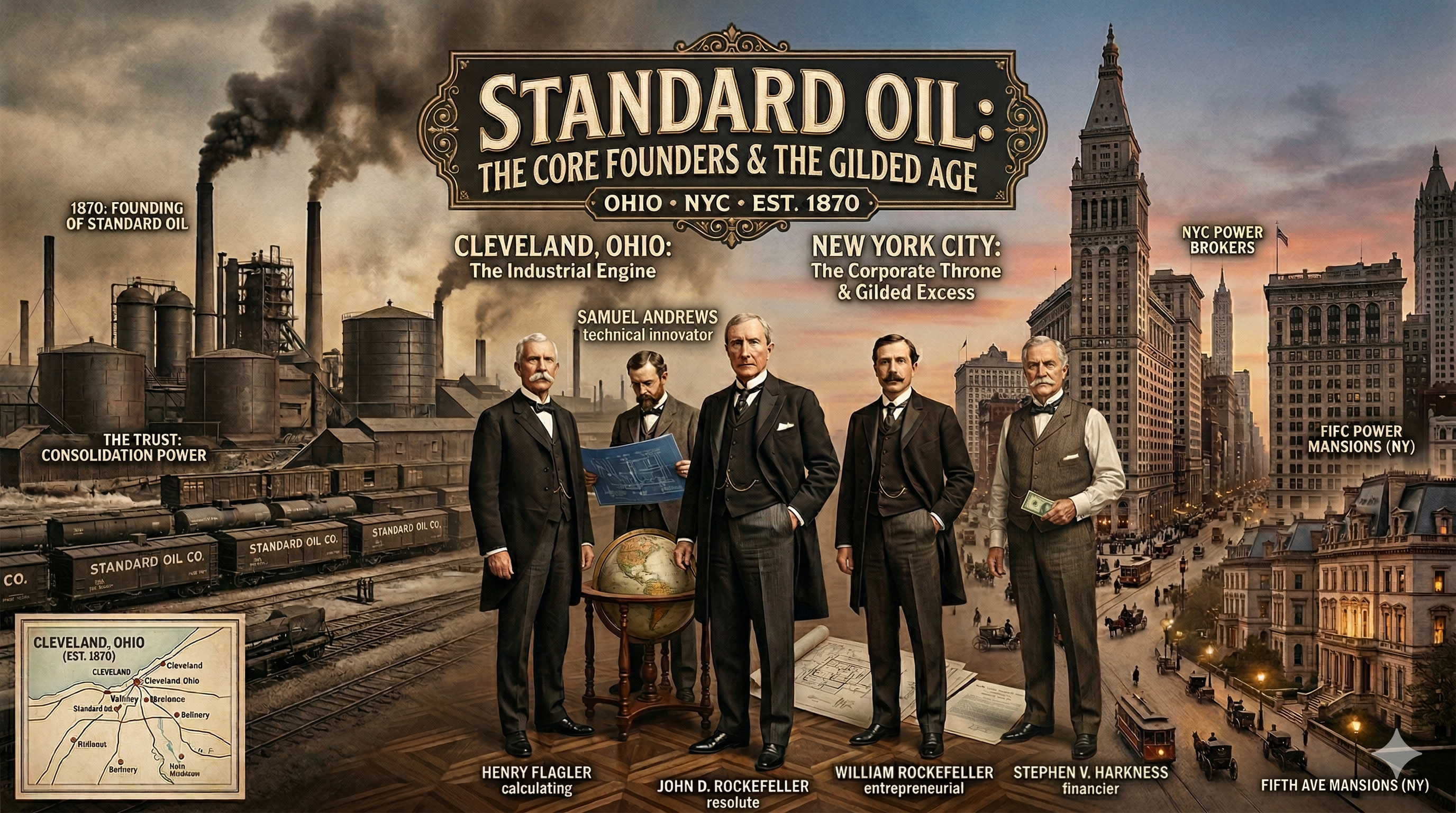
Our Standard Oil homepage hero seen here tells a story of Standard Oil and its Cleveland beginnings. While it is engaging and pretty accurate where faces etc are concerned, it does contain inaccuracies we would rather avoid but we felt this told the story pretty well and the rendering was largely accurate. The Lamon V. Harkness article also includes a few imagined boat voyages, among other experiments. The Image of the Great Skedaddle tells a story that there are no known images for. These examples reflect a balance we are still working through, not a claim that every detail is documentary. Honestly, its hard to keep the AI out but we do our best.
We also consider colorization and other visual treatments. Many readers today are accustomed to seeing the world in color, and such treatments can make the past feel more immediate. We use AI most to restore and colorize photographs, adding color and engagement to encourage younger generations to read and learn from our articles. A page of black-and-white pictures can put them off. Bringing in color and depth can help engage readers. However, colorization and AI restoration can also sometimes introduce details that were not in the original image. We aim to use it judiciously and keep accuracy in view. But, if there's a tradoff between getting people to read more about history and staying with pristine black and white photos, we lean to trying to engage reading further. Some areas we use AI:
Photograph restoration. A 130-year-old print or stereoview often carries dust, scratches, fading and tears. We carefully remove surface damage so you can see what the original lens captured, without altering faces, clothing or settings, and we always keep the untouched original.
Cross-referencing the record. We use research tools to compare census rolls, city directories, deeds and memorial records so timelines and family chronologies are accurate.
Source-anchored drafting. When writing help is used, it is tied strictly to documents we have gathered. Nothing goes in that cannot be traced to a source, and every word is reviewed by the editor before it is published.
Careful use of imagined scenes. A vivid reconstruction may help tell a story, but it should not be confused with a documented event or quotation.
The standards we aim to meet
No synthetic reenactments. We try to not publish AI-generated video reenactments of historical figures. There are a couple (e.g. traveo on Wakiva etc.) but we have kept this to a minimum.
No invented evidence. A generated image or imagined scene cannot establish what a historical person did, said or saw.
Care with historical imagery. We consider the source and limitations of photographs, engravings, plans and maps, including when images have been colorized or otherwise altered. We aim to use genuine period artifacts and guard against drastically changing any images.
Human editorial judgment. Technology may assist the work, but every story, profile and timeline is researched, curated and published by a person who answers for it.
Our promise to you
We are not claiming to use no AI or to get every detail right. We are trying to use new tools sparingly, thoughtfully and in service of accurate history. When you read Gilded Greats, our aim is to offer history grounded in research and true to the record. If you spot an error, or hold original documents that could deepen a story, use our feedback feature by highlighting any passage in an article or post to send the editor a private note. We care about accuracy but when looking back 150 years it can be difficult, thats why we are always open to your input.
— Don Schueler, Editor