
Historical article
Bluffton in Ashes: The Day the Lowcountry Burned
An excellent book by Jeff Fulgham about the Burning of Bluffton. On June 4, 1863, the small southern town of Bluffton, SC, was burned.
Further reading
As an Amazon Associate, we earn from qualifying purchases — at no cost to you.


On June 4, 1863 the small southern town of Bluffton, SC was burned. Contrary to common misconceptions, it was not burned by Sherman. Here is the story.
The Timeline
• July 31, 1844: The “Bluffton Movement” begins. Robert Barnwell Rhett addresses a crowd under the “Secession Oak,” calling for resistance against federal tariffs. This event establishes Bluffton’s reputation as a hotbed for secessionist sentiment nearly two decades before the Civil War.
• 1857: The Church of the Cross is completed. It would become one of the few structures to survive the eventual destruction of the town.
The War Reaches the Lowcountry (1861–1862)
• November 7, 1861: Union forces win the Battle of Port Royal and capture Hilton Head Island. Confederate General Thomas F. Drayton orders the evacuation of Hilton Head troops to Bluffton.
• Late 1861–1862: Fearing occupation, most residents abandon Bluffton in “The Great Skedaddle”. The town becomes a strategic outpost for Confederate pickets (lookouts) monitoring Union naval movements in the waterways.
• August 21, 1862: Confederate troops launch a surprise guerrilla raid on Union soldiers camped on nearby Pinckney Island, killing and capturing several dozen men. This style of warfare angers Union commanders and contributes to the later decision to destroy Bluffton.
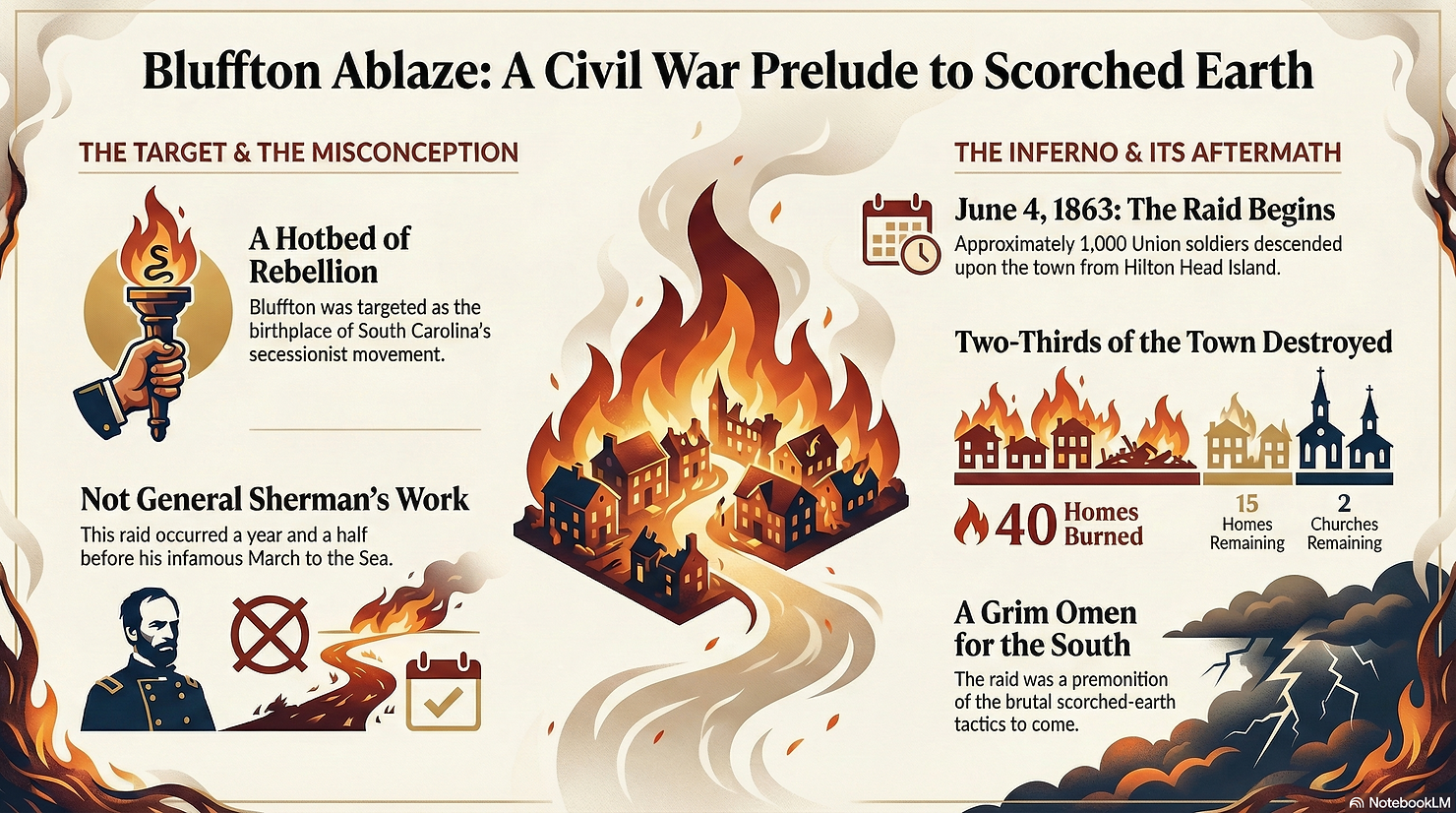
On a quiet summer morning in 1863, the peaceful calm of the May River was shattered forever. This wasn’t just another Civil War skirmish; it was a targeted act of retribution that would leave two-thirds of the picturesque southern town of Bluffton in smoldering ruins.
Not Sherman’s, but just as devastating
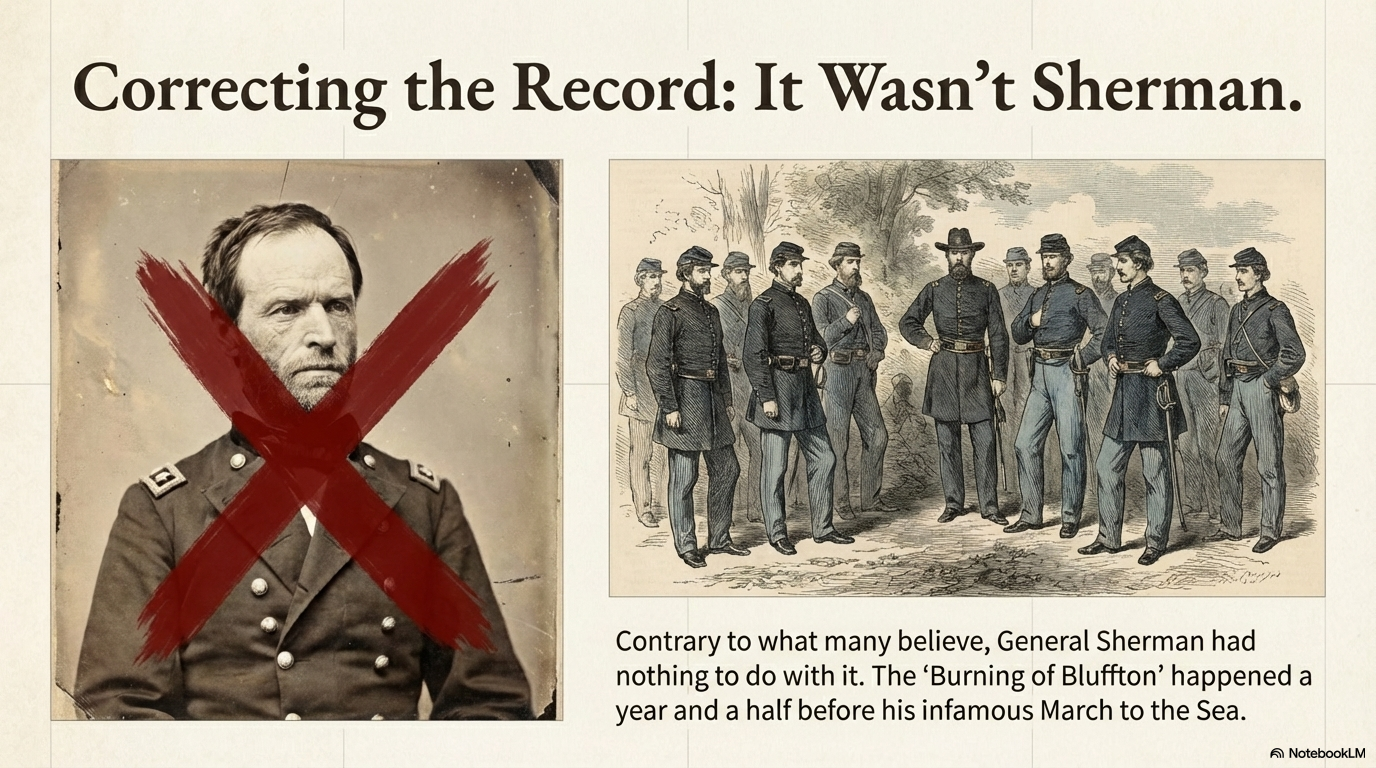
Contrary to what many believe, General Sherman had nothing to do with it. The “Burning of Bluffton” happened a year and a half before his infamous March to the Sea. The Union forces, stationed nearby on Hilton Head Island, had a specific target in mind. Bluffton wasn’t just another sleepy Southern town—it was the birthplace of the secession movement in South Carolina, a hotbed of anti-Union sentiment known as the “Bluffton Movement.” This made it a symbol of rebellion and, in the eyes of the Union, a prime target for a lesson in war’s harsh reality.
The raid and the ruins
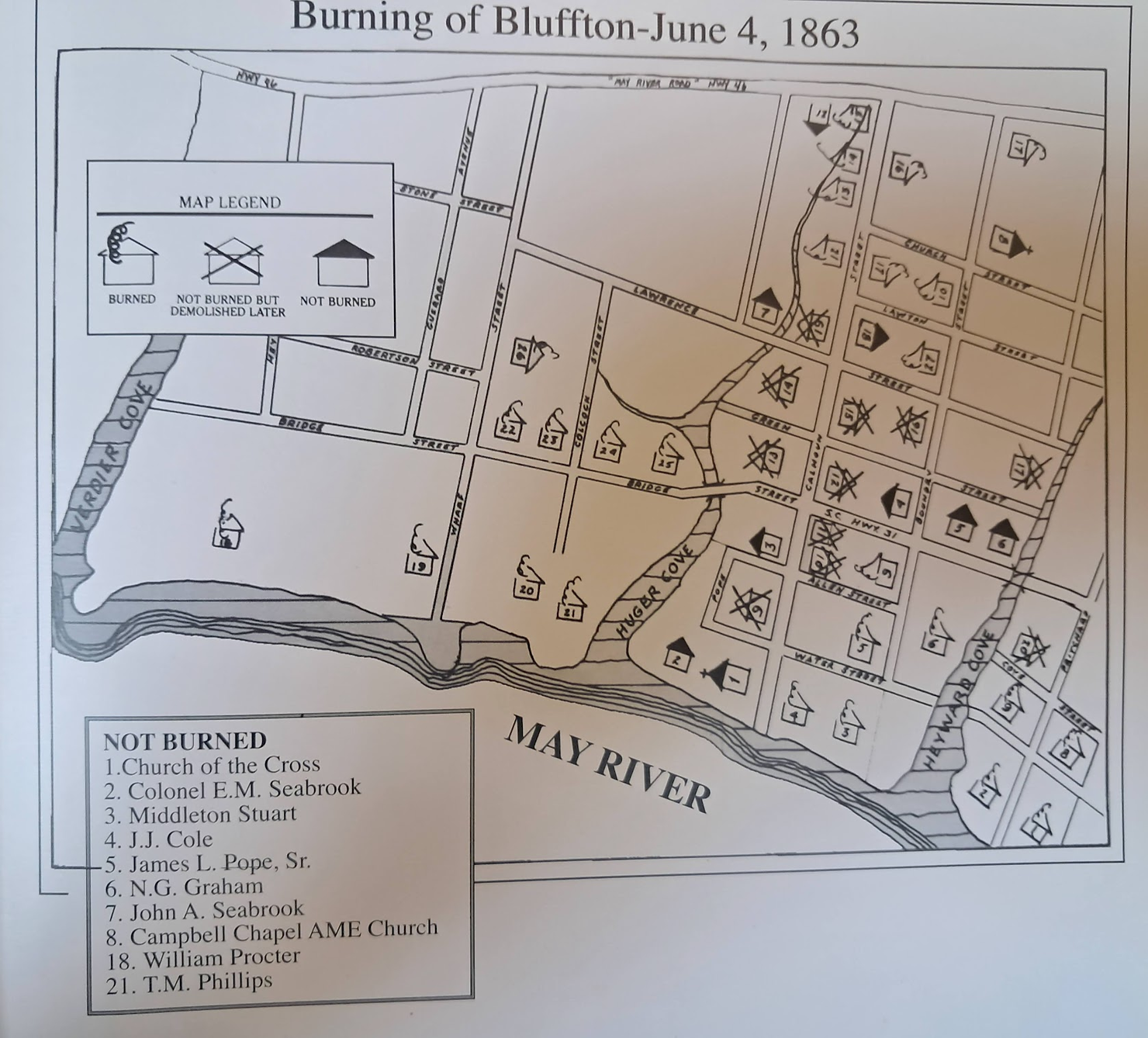
On June 4, 1863, about 1,000 Union soldiers descended upon the town. After a brief scuffle with a small Confederate defense, the torches were lit. Roughly 40 homes and numerous outbuildings were engulfed in flames, leaving families homeless and the once-charming village in a state of utter devastation. Only two churches, the Campbell Chapel AME Church and the Church of the Cross, along with just 15 private homes, were spared the inferno.
A grim omen for the South
The raid was a shock to the Confederacy, which saw it as “fiendish vandalism.” But for the Union, it was a morale-boosting success. In the end, the raid had a long-lasting impact, leaving scars that would take decades to heal. The burning of Bluffton was not just a military action—it was a premonition of the scorched-earth tactics that would soon define the final years of the war.
The Expedition and Burning (1863)
• May 27, 1863: Union Major General David Hunter formally requests naval assistance to mount an attack on Bluffton, with the specific intent of destroying the town by fire.
• June 3, 1863: Rear Admiral Samuel Francis Du Pont instructs Lieutenant Commander George Bacon to lead the naval portion of the expedition.
• June 4, 1863 (The Burning of Bluffton):
◦ Early Morning: A Union force of approximately 1,000 men lands at Hunting Island Plantation, two miles downstream from Bluffton.
◦ Approx. 7:30 AM: Union troops enter Bluffton. The heavily outnumbered Confederate infantry retreats to a defensive position west of town.
◦ Mid-Morning: Under orders, Union soldiers fan out and torch the town. The destruction claims approximately 40 private residences and nearly 100 outbuildings. Two-thirds of the town is destroyed.
◦ The Skirmish: A Confederate force of roughly 238 cavalrymen attempts to engage the Union troops but is repelled by shrapnel and shell fire from the Union gunboat Commodore McDonough.
◦ Survival: The Church of the Cross is spared, partly due to the heavy tree growth protecting it. The Huger-Gordon House remains the only antebellum house on the bluff to survive. A fire set at the Methodist Church is extinguished by Union troops before it can consume the building.
◦ 12:00 PM: Union troops re-embark on their ships and return to Hilton Head without suffering casualties.
The Aftermath
• June 6, 1863: The Charleston Mercury reports on the event, describing it as a “mortifying circumstance” and detailing the loss of property.
• June 12, 1863: The New York Times reports that “desolation, ruin and desecration have been left behind.”
• Post-War: The town eventually rebuilds, but the event is remembered as a localized precursor to the “scorched earth” tactics General Sherman would later employ across the South.