
Historical article
The Great Skedaddle of 1861
To understand “The Great Skedaddle” in its entirety, you have to look at it as a tale of two panics: one military and one civilian.
To understand “The Great Skedaddle” in its entirety, you have to look at it as a tale of two panics: one military and one civilian. While the term was born from a Union disaster in Virginia, it found its most haunting expression in the salt marshes of the South Carolina Lowcountry.
The Universal Definition: A Collapse of Order
In the 1860s, “skedaddle” was the era’s “viral” word. It described a specific kind of flight: not a tactical retreat, but a total, frantic loss of nerves.
The Origin (July 1861): At the First Battle of Bull Run in Virginia, the Union Army broke and fled toward Washington, D.C. They famously collided with wealthy civilians who had come to “watch” the battle with picnic baskets.
The Connotation: The Northern press used the word to mock the cowardice and lack of discipline in the early volunteer army.
The Local Reality: Bluffton, SC, and the Lowcountry
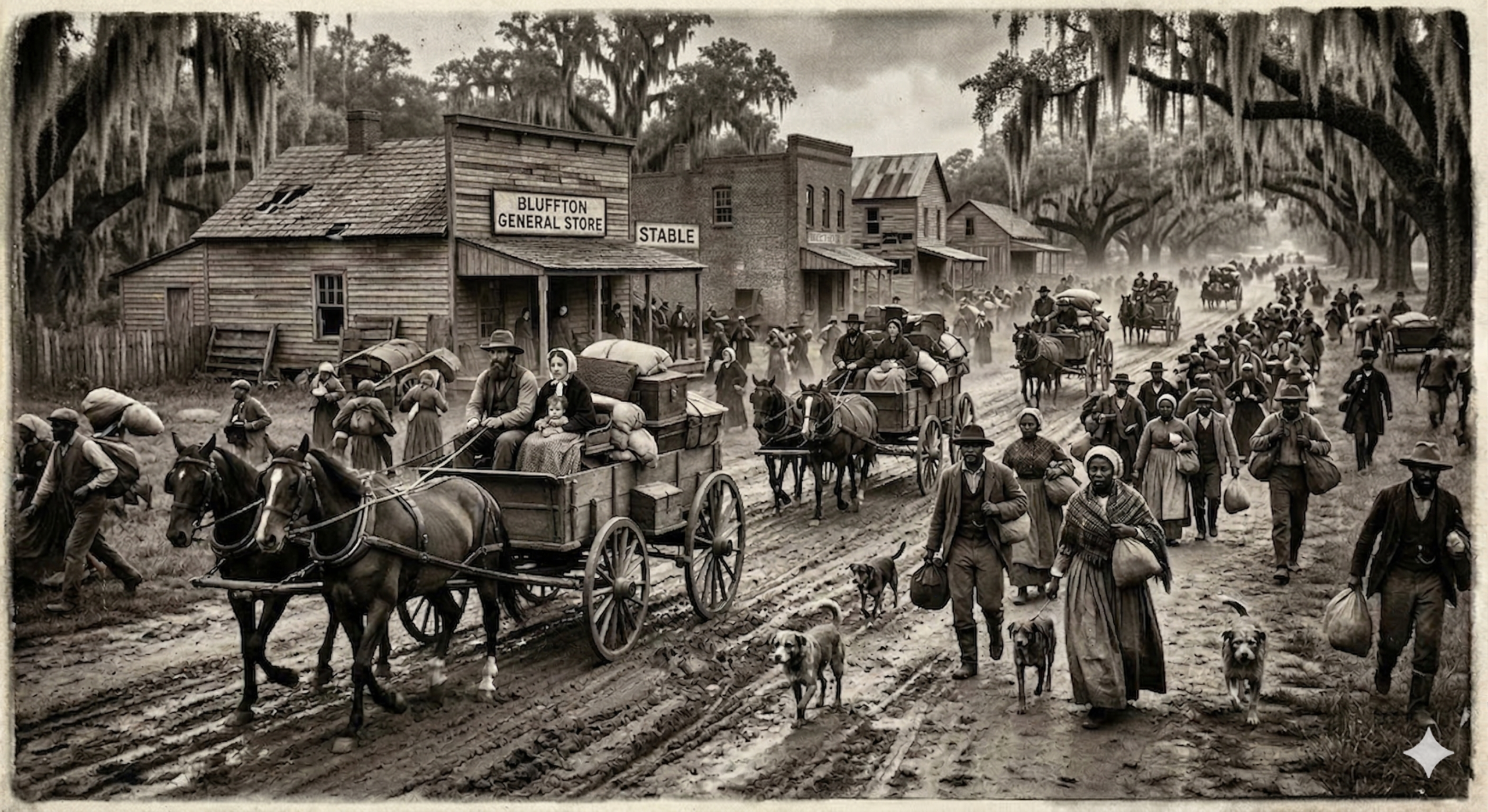
By November 1861, the “Skedaddle” migrated south. For Bluffton, SC, it wasn’t a military rout—it was the instant abandonment of an entire society.
The Flight (November 1861)
When the Union Navy won the Battle of Port Royal, the thunder of the guns could be heard across the May River. The white planter class of Bluffton, realizing their coastal defenses had vanished, fled within hours.
The “Main”: Residents fled to the interior (Hardeeville and beyond), leaving behind fully furnished mansions, silver, and unharvested crops.
The Power Shift: This exodus left thousands of enslaved people behind. In the absence of their owners, they claimed their freedom, eventually forming the basis of the Gullah-Geechee communities and the Port Royal Experiment.
The Aftermath and The Fire (1863)
Bluffton spent the next two years as a “Ghost Town.” Confederate scouts used empty mansions as lookout posts, while Union troops on Hilton Head watched from across the water. The saga ended in June 1863, when Union forces—seeking to punish the “cradle of secession”—landed and burned roughly 75% of the town. There were 13 buildings – “The Lucky 13” – that survived. The “Skedaddle” that began with a panicked flight ended in a wall of smoke.
Bluffton’s “Skedaddle” Survivors
Today, the physical legacy of the Great Skedaddle is seen in the few buildings that survived both the abandonment and the subsequent torches.
StructureRole in the Skedaddle / Survival StatusChurch of the CrossThis c. 1857 Gothic Revival masterpiece was spared by Union troops and remains the town’s most iconic sentinel.Heyward HouseThe family fled in 1861; the c. 1841 home was later spared from the fire and serves as the town’s Welcome Center and Museum.Huger-Gordon HouseBuilt c. 1795, it is the only antebellum home on the bluff to survive the 1863 raid; musket balls are still lodged in its front door frame.The Seven OaksA c. 1850 residential survivor named for the massive oak stumps that originally served as its foundation.The Card HouseA c. 1825 survivor that, according to local lore, was once won in a high-stakes poker game.Squire Pope Carriage HouseWhile the main estate was burned, this outbuilding survived and was later repurposed into a residence.
The Takeaway
“The Great Skedaddle” is the pivot point of Bluffton’s history. It represents the moment the Old South “scurried” away, leaving a vacuum that would eventually be filled by the reconstruction of the South and the birth of the modern Lowcountry. The few homes standing today are more than just architecture; they are the literal witnesses to the day a society vanished overnight.
Here are some of the homes still standing.