
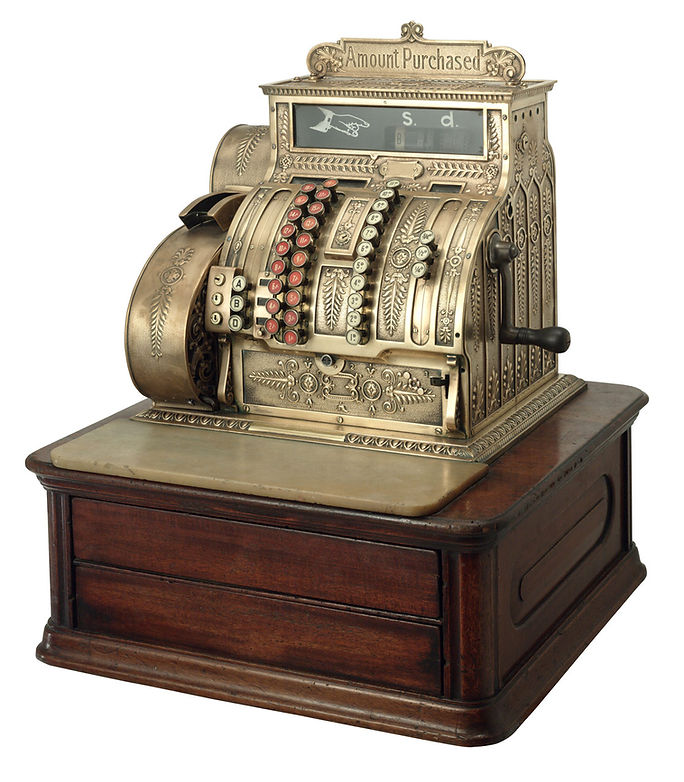
Historical article
Where did all the money go?
The Standard Oil fortune was a tidal wave of cash that either built the foundations of modern America or dissolved into a haze of eccentric scandals, proving that inheriting a billion dollars is often the quickest way to lose your mind.
Where did all the money go you ask?
The Standard Oil fortune was a tidal wave of cash that either built the foundations of modern America or dissolved into a haze of eccentric scandals, proving that inheriting a billion dollars is often the quickest way to lose your mind.
The Flagler Infrastructure Gamble: Henry Flagler poured his $15,700,000,000 (inflation-adjusted) fortune into the Florida mud, building a railway over the ocean and a string of hotels. He famously claimed he would have been a “truly wealthy man” if he hadn’t invested in the state—leaving behind a legacy that changed a coastline but nearly drained a titan.
The “Bypassed” Bloodline: Due to a bitter estrangement and a son’s “unacceptable” pursuit of the arts, the Flagler inheritance performed a radical pivot. Instead of going to his only heir, the wealth landed in the lap of his third wife, Mary Lily Kenan, sparking a chain of events that funneled millions into Southern institutions while leaving his biological legacy in the cold.
The Harkness Philosophy of “Trust”: While other heirs treated their wealth like a personal playground, Stephen V. Harkness’s family viewed their $20,000,000,000 share as a “public trust.” They pioneered a methodical liquidation strategy that prioritized strategic distribution over luxury, but their “frugality” came with a hidden social cost.
Edward Harkness’s Academic Revolution: As one of history’s most prolific donors, Edward Harkness didn’t just give money; he forced a total redesign of American elite education. He single-handedly funded the residential college systems at Yale and Harvard and invented the “medical center” model—but his reasons for choosing Columbia-Presbyterian over other rivals were deeply personal.
Two Paths to Obsolescence: These histories reveal the ultimate Gilded Age tension: some fortunes were exhausted through hyper-ambitious regional development, while others were methodically dismantled via philanthropy. Both paths led to the same result—the total disappearance of the original family’s liquid power within three generations.
Think you know what “Old Money” looks like? Read the full article below to see the specific, scathing remark Henry Flagler made about his own net worth and the bizarre “artistic” career path that caused him to disinherit his own son.
The Flagler and the Harkness fortunes combined were very significant. After all, they represented approximately 32% of the whole of Standard Oil along with other investments. So if that’s the case, where did the money go?
Henry Flagler
A large portion of Henry’s money ended up in Florida. Building a railroad from Jacksonville all the way down to Key West is a pricey endeavor. Add to that all the magnificent hotels and supporting churches and other buildings and you can see where much of his money went. He is quoted as saying “I would have been a rich man if it wasn’t for Florida”. Henry’s only child to survive him was his son Harry. He once said:
“I do not expect, during my lifetime, to get any monetary gain from the vast expenditure of time, money and thought that I am making in Florida. If I am spared long enough to carry out my plans I shall be satisfied. I have been singularly blessed in my business career and I feel that where a man has been blessed with more than usual success he will be held responsible to his maker for the use of that money he’s put to. Others have built churches, libraries and schools. These will pass away with time and the givers will be forgotten. But the building of the Florida East Coast Railroad and the opening of the wilderness will not be effaced by time but will rather grow in value as the years go by and as people come in and possess the land. I am confident that the railroad I am building will in time become the most valuable railroad property in the world.” – Henry Flagler
Henry was estranged from Harry and only left him a small portion of his estate. The largest part of Henry’s fortune was left to Mary Lily Kenan, and she and Henry had no children together. Henry died in 1913 and Mary Lily married Robert Worth Bingham in 1919. Mary Lily died just a year later in 1917. Robert Bingham received $5 million but the rest of the Flagler fortune went to Mary Lily’s family. William R. Kenan Jr. and Mary Lily’s sisters Jessie Kenan Wise and Sarah Graham Kenan and niece Louise Wise, were all recipients of her will’s largess.
The drama surrounding the Flagler fortune is a classic American tale of Gilded Age wealth, family friction, and suspicious timing. To understand how the Kenan family ended up with the lion’s share of the Flagler legacy, we have to look closer at the specific timeline and the fallout of Henry Flagler’s personal choices.
The Estrangement: Henry vs. Harry
Henry Flagler’s relationship with his only son, Harry Harkness Flagler, was fractured beyond repair long before Henry’s death. Henry was a man of relentless industry and “Old School” discipline; Harry, by contrast, showed little interest in the Standard Oil or Florida East Coast Railway empires.
The final straw came when Harry chose to pursue a life in the arts and music rather than business. When Henry passed away in 1913, his will was a cold reflection of this disappointment. While Harry wasn’t completely cut off, he received only a fraction of the estate, ensuring he would live comfortably but never control the vast industrial empire his father built.
The Rise of Mary Lily Kenan
With Harry sidelined, the bulk of the fortune—estimated at roughly $60 million to $100 million (billions in today’s currency)—passed to Henry’s third wife, Mary Lily Kenan.
The Marriage: They married in 1901, when Mary Lily was 34 and Henry was 71.
The Inheritance: Since they had no children, Mary Lily became the wealthiest woman in the world upon Henry’s death.
The Second Marriage: In 1916, Mary Lily married Robert Worth Bingham, a judge from Louisville. This marriage was shrouded in controversy from the start, as many in Mary Lily’s inner circle distrusted Bingham’s motives.
The Mystery of 1917
There is a slight chronological correction needed for the narrative: Mary Lily died in 1917, just eight months after marrying Bingham (not 1920). Her death was sudden and sparked immediate rumors of foul play, including whispers of morphine addiction or even poisoning, though nothing was ever proven.
Before her death, Mary Lily added a codicil (an amendment) to her will, granting Robert Bingham $5 million. While this was a massive sum at the time, it was a “consolation prize” compared to the total estate.
The Kenan Windfall
The remaining tens of millions flowed back to the Kenan family, cementing their status as one of the most powerful dynasties in the South.
RecipientImpact of the InheritanceWilliam R. Kenan Jr.He used his share to maintain the Flagler enterprises, becoming a titan in his own right and a major benefactor to the University of North Carolina.Jessie Kenan WiseHer portion helped establish the family’s long-standing philanthropic footprint in Wilmington and beyond.Sarah Graham KenanShe became one of North Carolina’s greatest philanthropists; the Sarah Graham Kenan Foundation still funds arts and education today.Louise Wise (Niece)Representing the next generation, her inclusion ensured the fortune remained tightly held within the Kenan bloodline.
The Legacy of the Codicil: Robert Bingham used his $5 million “inheritance” to purchase the Louisville Courier-Journal, turning it into a media powerhouse. Meanwhile, the Kenans used the Flagler fortune to build hospitals, university stadiums, and libraries, ensuring that while Henry Flagler’s son was left out, his money would define the infrastructure of the American South for a century.
Stephen V. Harkness
His fortune went to his wife and children, and much was ultimately devoted to philanthropic purposes by his children. Edward Harkness and his mother Anna did a great job of giving away the family fortunes. Many of their philanthropic efforts still stand or function to this day.
Edward S. Harkness: The Silent Donor
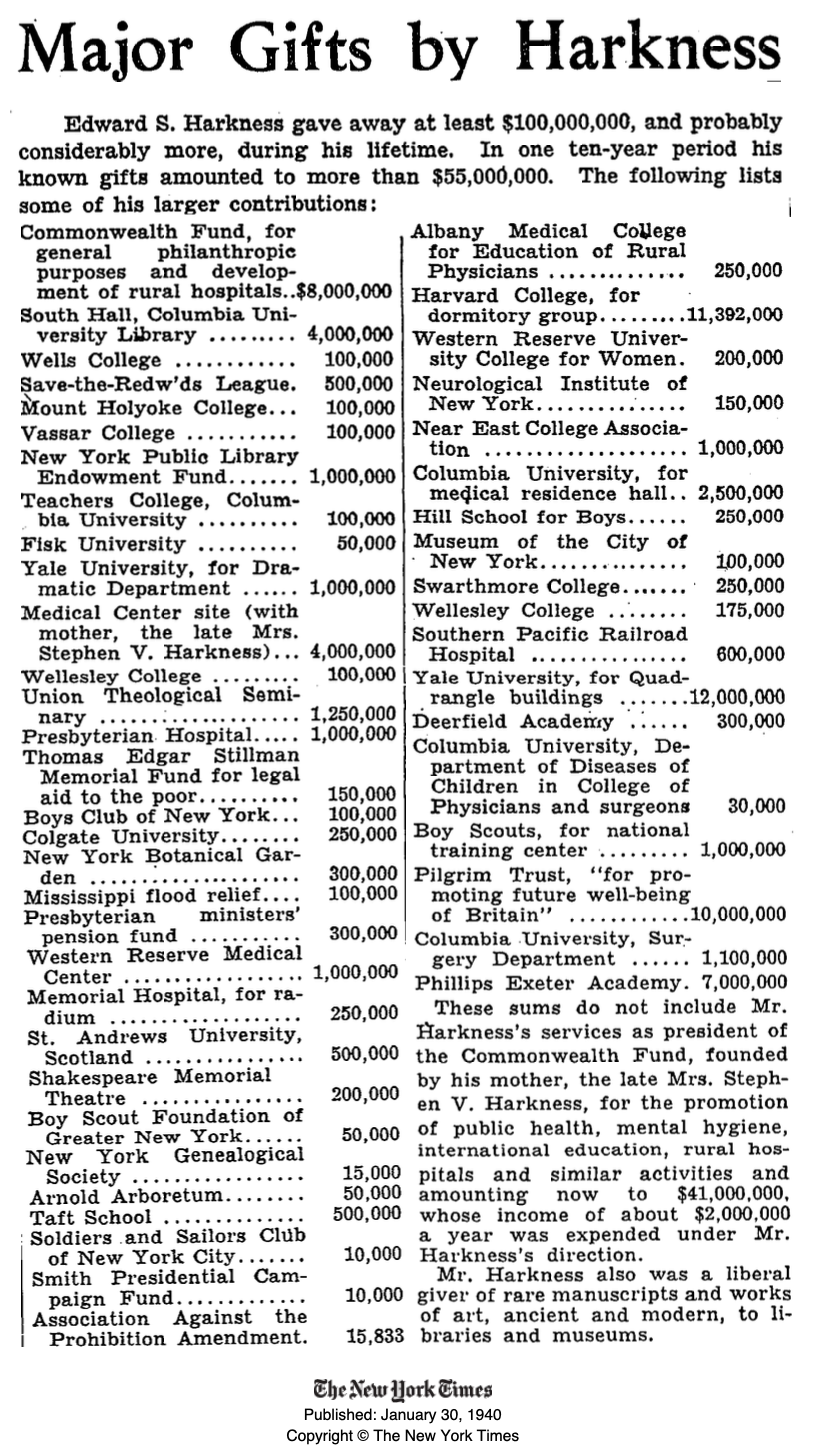
Edward Harkness is often called “the most modest of the great philanthropists.” He spent his life systematically giving away an estimated $129 million (roughly $2.5 billion today). His philosophy was rooted in the idea that wealth was a “trust” to be managed for the benefit of others.
1. The Transformation of Higher Education
Edward believed that the massive growth of universities like Harvard and Yale was making education too impersonal.
The House System: He donated $13 million to Harvard and $15 million to Yale to build “Residential Colleges.” These allowed students to live and learn in smaller, intimate communities, modeled after the colleges at Oxford and Cambridge.
The Harkness Table: At Phillips Exeter Academy, he famously challenged the faculty to move away from lectures. His $6 million gift established a pedagogy where 12 students and a teacher sit around a large oval table, forcing every student to participate as an equal.
2. The Medical Center Concept
Edward and his wife, Mary Stillman Harkness, were the driving forces behind the Columbia-Presbyterian Medical Center (now NewYork-Presbyterian).
They donated the land (formerly a baseball park) and tens of millions of dollars to merge a teaching hospital with a medical school. This “medical center” model—where research, teaching, and patient care happen in one complex—became the global standard for modern healthcare.
3. Cultural Conservation at The Met
As a trustee of the Metropolitan Museum of Art, Edward was obsessed with Egyptian archaeology.
He personally underwrote the Lord Carnarvon excavations that eventually led to the discovery of King Tut’s tomb.
His gifts include the Tomb of Perneb and the iconic blue faience hippopotamus known as “William,” which has served as the museum’s unofficial mascot for over a century.
The Legacy of No Heirs
A unique aspect of the Stephen V. Harkness branch is the lack of direct descendants.
Edward and Mary had no children.
Charles Harkness (Edward’s brother) also died without children.
Because there were no heirs to protect the fortune, Edward and Anna were free to give away nearly the entire estate during their lifetimes. They focused on “self-sustaining” gifts—endowing universities, hospitals, and museums so that the institutions would continue to function long after the Harkness name faded from the headlines.
Robber Baron – Yes or No?
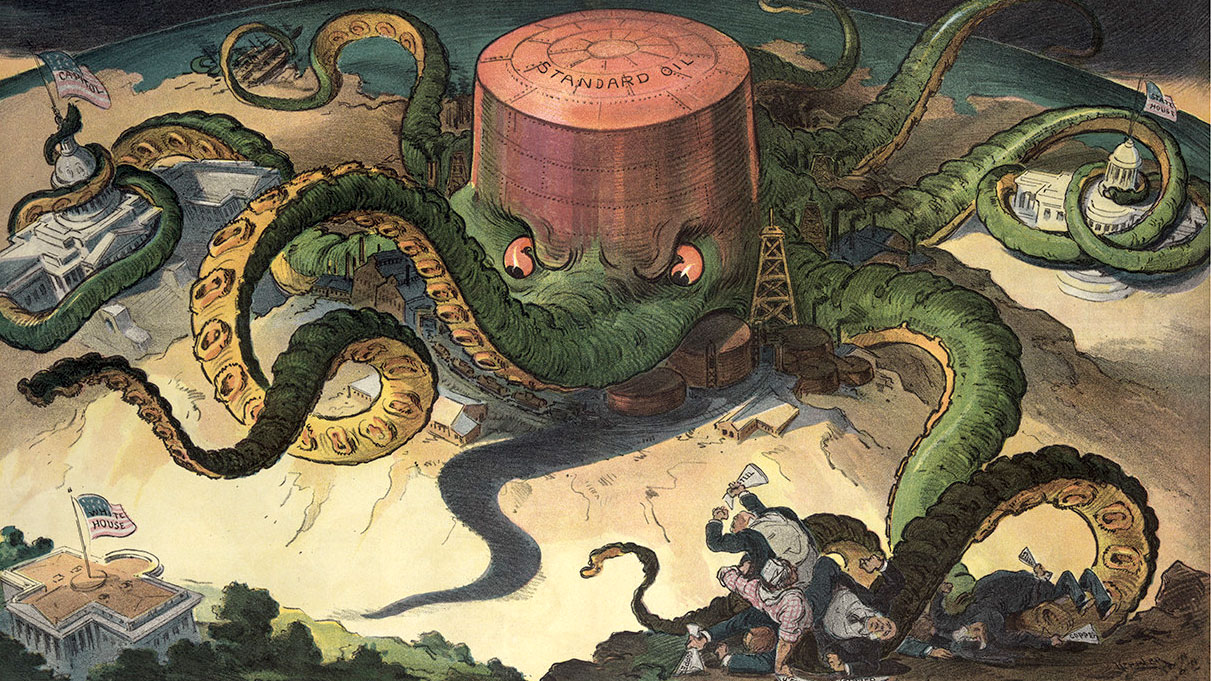
Did the Gilded Age have robber barons? Certainly, much like the current era.
Today, while the Harkness name is rarely mentioned alongside Rockefeller or Carnegie, their influence is arguably more intimate: it is found in the way students learn, how hospitals are organized, and how the public experiences ancient history.
None of Stephen’s children, other than Lamon, had children of their own. Lamon’s son Harry Harkness died young and did not have children. His two daughters, Lela and Myrtle, survived him. Myrtle and Kingsley Macomber had a daughter, Priscilla Amelia, who unfortunately passed away at the age of 9 months. Myrtle married Prince Lela had 3 children: daughters Martha and Lela, and a son, Harkness. Lamon’s estate and property, including Walnut Hall, passed to his heirs.
Daniel M. Harkness – Daniel had only one surviving child, William L. Harkness. Will then had two children, Louise Hale Harkness (1898-1978) and William Hale Harkness (1900–1954). Bill had two children: one from his first marriage, Anne, and a second child, Edith, with his second wife Rebekah. Rebekah spent most of what she inherited from Bill, and Edith never married and only lived two months after her mother Rebekah passed away. Louise Hale Harkness married David Sinton Ingalls. Louise and David’s philanthropic and charitable work is still functioning today as well.