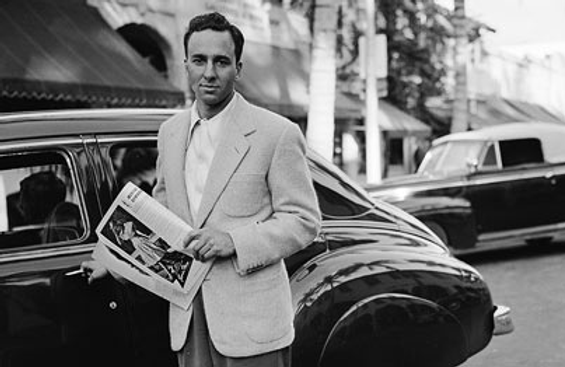
Historical article
George Huntington Hartford II – The Visionary Life and Fall of an Heir
What is interesting about George Huntington Hartford II? The Bluffton SC Connection He is connected to the Souther Gilded Age through his mother from Bluffton SC, Henrietta Pollitzer Hartford.
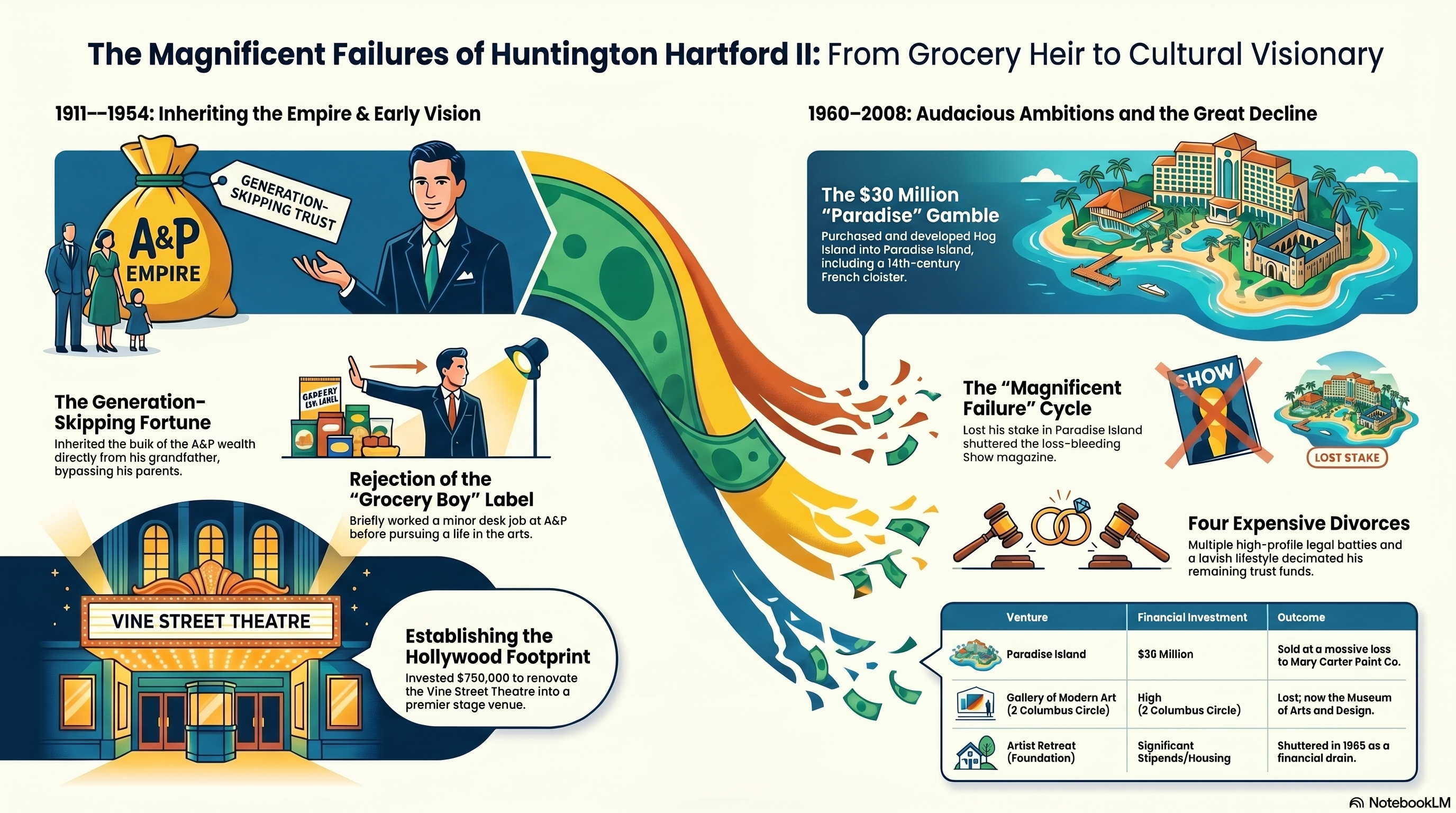
What is interesting about George Huntington Hartford II? The Bluffton SC Connection
He is connected to the Souther Gilded Age through his mother from Bluffton SC, Henrietta Pollitzer Hartford. He was also the heir to a billion-dollar grocery empire who arrived for his first day of work in a chauffeur-driven Rolls-Royce—only to be fired shortly after. George Huntington Hartford II was a man determined to be anything but a “grocery boy.”
From importing a 14th-century French cloister to the Bahamas to building a “Lollipop Building” in the heart of Manhattan, his life was a whirlwind of audacious gambles and “magnificent failures.” He spent $30 million to turn a desolate island into a tropical paradise and once hired Frank Lloyd Wright to design a resort that never was.
But how did the man who once held the world’s largest retail fortune end up in a run-down estate with his riches almost entirely vanished? Discover the wild, eccentric, and ultimately tragic saga of the Gilded Age’s most colorful “playboy” philanthropist—and his surprising connection to the South Carolina Lowcountry. READ ON for more information about Hunt Hartford’s escapades….
Your initial thought on opening this post may be, “What is the relevance of Huntington Hartford in this Southern Gilded context?” This is a valid question. The main reason is his connection to Bluffton, SC, through his mother, Henrietta Pollitzer, which ties him to the Lowcountry and the Bluffton/Beaufort region. He was born on April 18, 1911, in New York City to Henrietta Pollitzer Hartford and her spouse, Edward V. Hartford, who was an heir to the substantial A&P grocery store fortune.
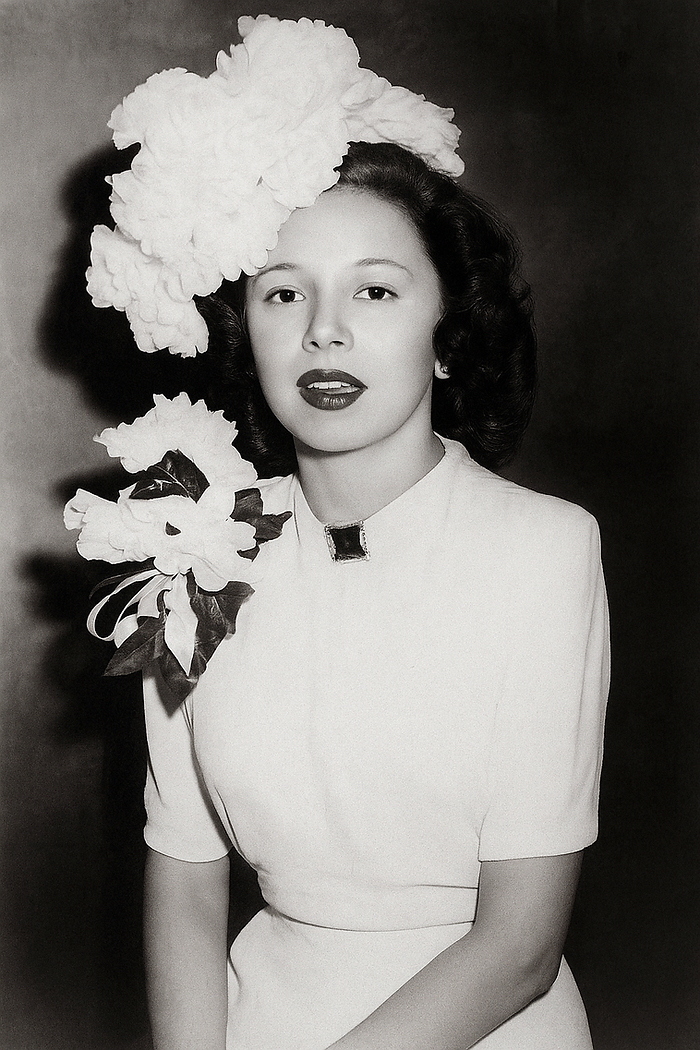
Henrietta Pollitzer
View this person’s profile
Huntington Hartford was an influential American entrepreneur, philanthropist, and art collector, recognized primarily for his ties to the A&P grocery chain and his ambitious pursuits in the arts and real estate. His life was characterized by notable successes and failures that mirrored the evolving landscape of American business and culture.
It is unclear whether Henrietta ever brought Huntington, known as “Hunt,” to Bluffton or Beaufort, SC. It is likely he visited a few times during his childhood to see his grandparents and cousins, but there are no concrete records to verify this. Transitioning from New York City society to Bluffton or Beaufort would have been quite a change for him. At that time, Beaufort’s population was probably around 2,500, while Bluffton’s was closer to 500. Apart from activities in Savannah and possibly at some of society’s hunting plantations—such as Alfred Loomis’s on Hilton Head and the Chelsea Plantation Club in Okatie—there wouldn’t have been much to do. Hunt wasn’t particularly interested in hunting; he was a tennis player, but there likely wasn’t much to keep him entertained. He did have at least a business connection to Marshall Field III who owned nearb Chelsea Plantation.
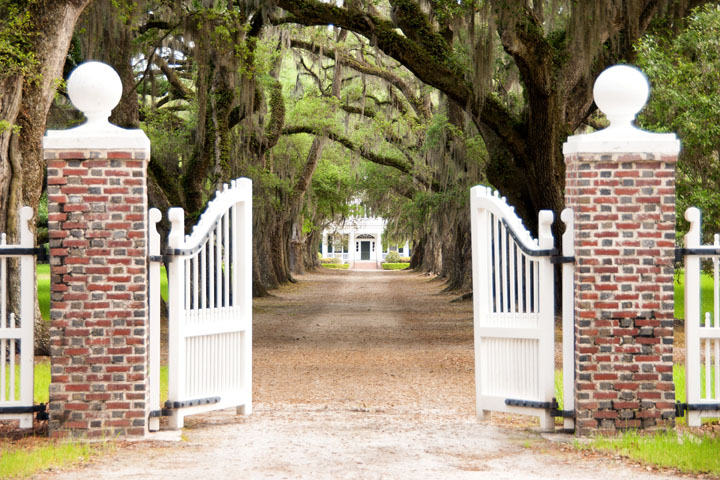
Chelsea Plantation – Ridgeland, SC
Chelsea Plantation Okatie SC One of the most beautiful properties in the Lowcountry of South Carolina is in Okatie, SC, between Bluffton, SC, and Beaufort, SC, along the Okatie River.
Hunt and his mother were also friendly with the Wilsons from nearby Palmetto Bluff, but that burned down in 1926 when Hunt would have been 15 years old – though it’s possible he visited there.
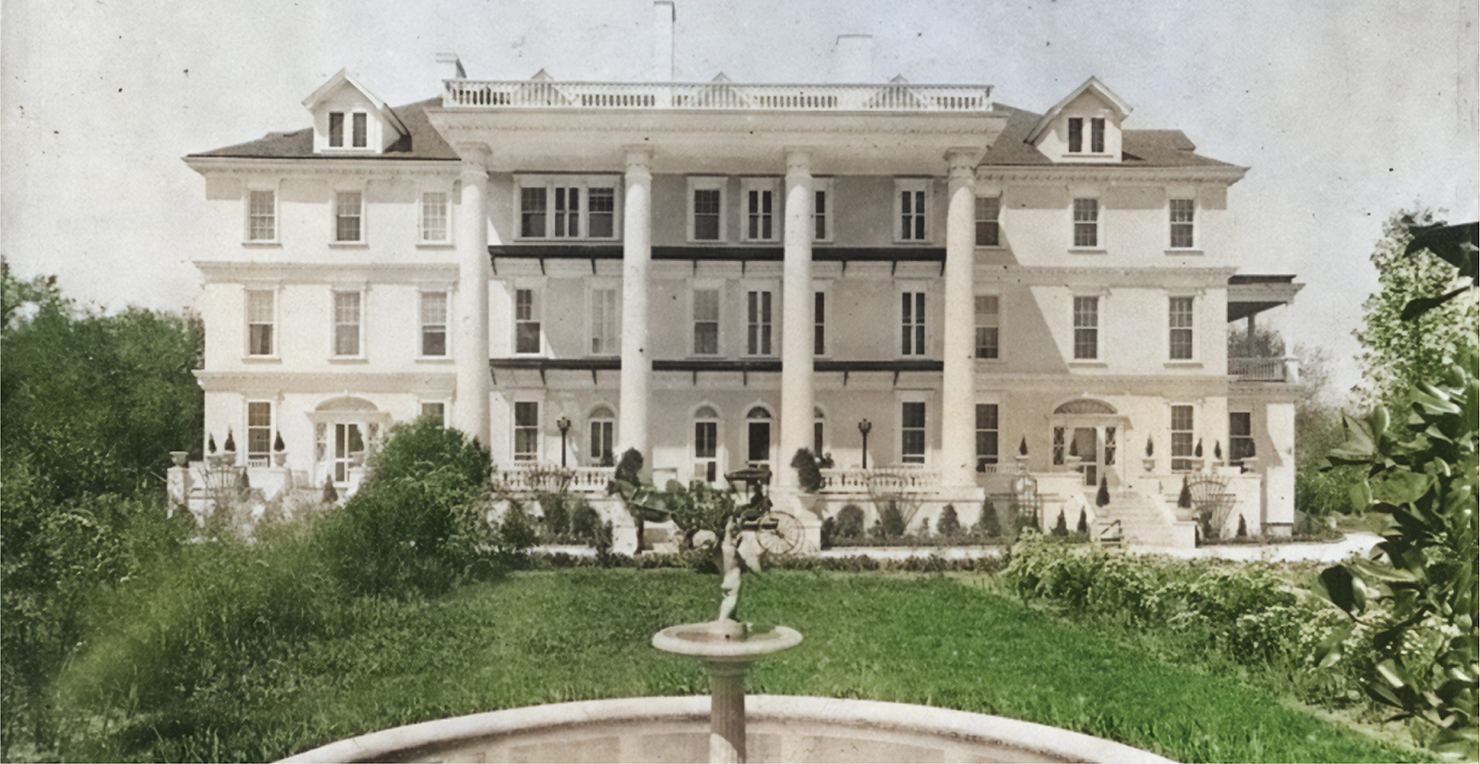
Palmetto Bluff – Richard Thornton Wilson Jr. & The “Marrying Wilsons”
Palmetto Bluff and the Marrying Wilsons If you’ve recently been to the Bluffton, SC area, you might know about the Palmetto Bluff Development.
Early Life and Background
Huntington Hartford was born on April 18, 1911, in New York City. As the grandson of George Huntington Hartford, a co-founder of the A&P grocery empire, he inherited significant wealth and influence early in life. His father, Edward V. Hartford, died in 1922 when Huntington was only 11, leaving him with his mother, Henrietta. Edward’s will was just 10 sentences long, leaving everything to his wife Henrietta. The problem was, there wasn’t much left in his estate. The real fortune was left by Edward’s father George to Edward’s children, not Edward and Henrietta. So in reality, Huntington and his sister Josephine (who married in 1923) had the largest wallets as a result of the generation-skipping trust.
Henrietta focused on enrolling Hunt in prestigious schools, arranging suitable marriage prospects, and securing their social standing. She successfully lobbied to have some access to the fortune so Hunt could be raised in the proper way. However, as the saying goes, “The best-laid plans…”
Hunt attended St. Pauls School in Concord, NH, for 6 years for his college prep – a member of the form of 1930. It was a tough road for Hunt. The Hartfords were “new money,” and while he was wealthier than most of his classmates, Hunt was always an outsider and not accepted.
However, in his senior year he was caught looking over the shoulder of another student. Whether he was copying answers or not will never be confirmed…but that wasn’t important in those days. He didn’t graduate with the class as a penalty for his infraction.
Henrietta bought Seaverge in Newport in 1927 and settled in 1928. The Newport Casino was the bastion for all things tennis, including grass courts, and was a social draw. It hosted the Perpetual International Championship Cup between Oxford, Cambridge, Harvard and Yale. The timing was perfect for Henrietta, and she launched herself and Hunt into Newport Society at the start of “Tennis Week” by throwing a ball for 400 at Seaverge in July 1929. On her huge guest list was a who’s who of Newport Society, including Mrs. R.T. Wilson and her daughter Marion of Palmetto Bluff in Bluffton, SC, and Shady Lawn in Newport.
Palmetto Bluff – Richard Thornton Wilson Jr. & The “Marrying Wilsons”
Palmetto Bluff and the Marrying Wilsons If you’ve recently been to the Bluffton, SC area, you might know about the Palmetto Bluff Development.
The effort was successful since she and Hunt finally were included in the “Social Register”. In 1923 A&P surpassed Sears and became the largest chain store in the world.
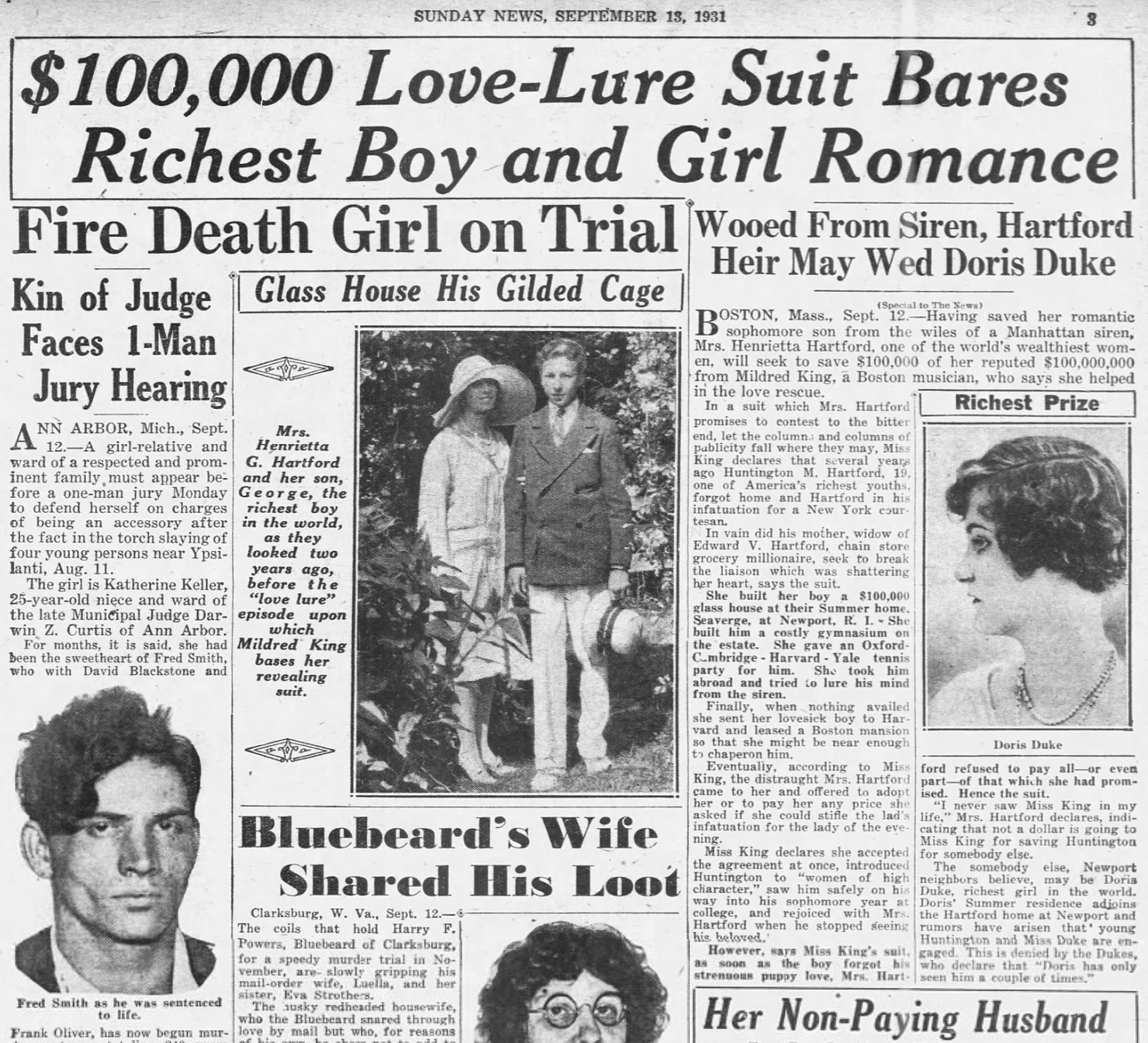
When he was 20 years old, just about to reach his age of majority, Henrietta was busy trying to marry Hunt off to Doris Duke. It didn’t work out though.
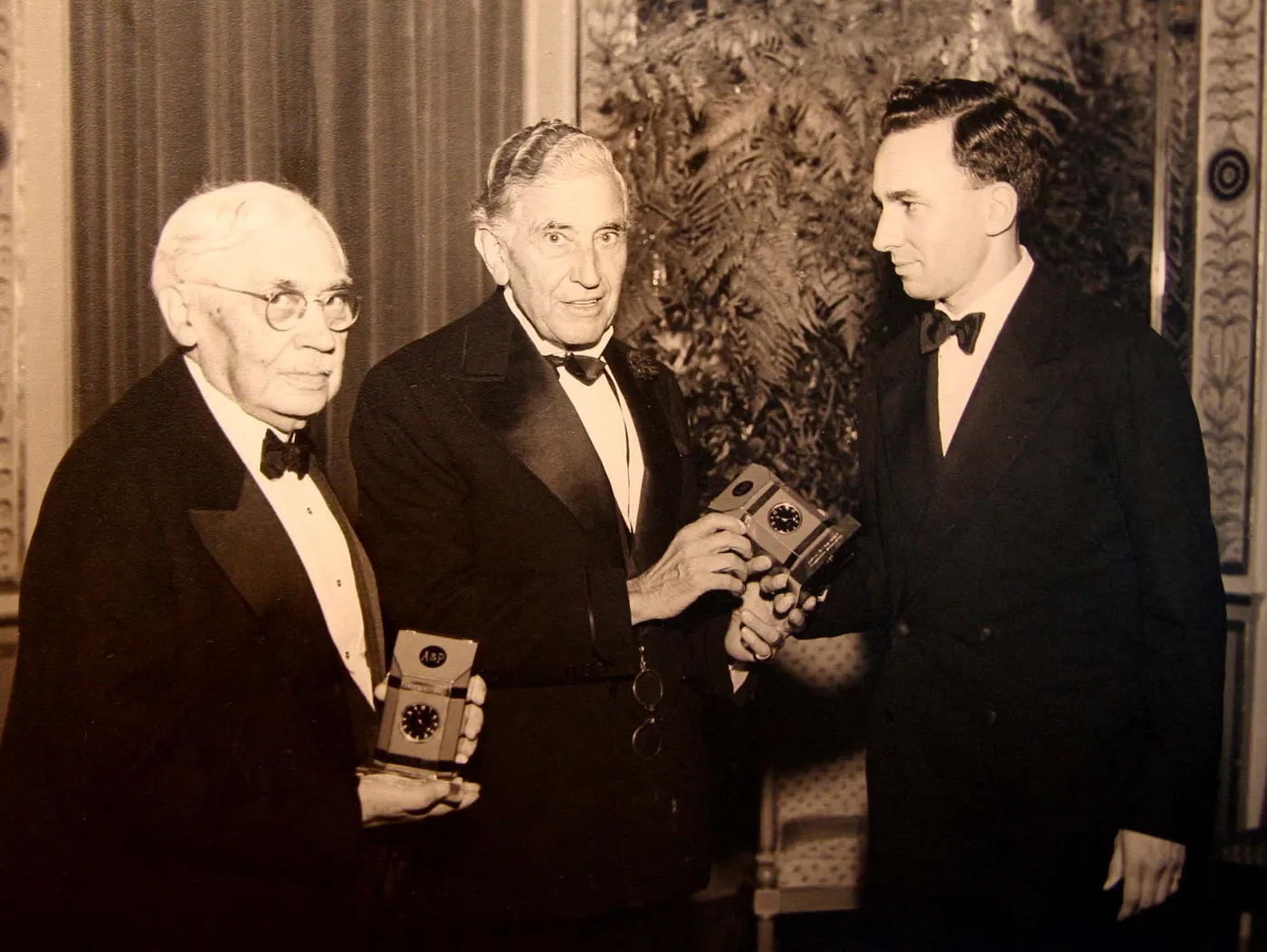
John and Edward Hartford, A&P Heirs with Huntington. They ruled A&P with an iron grip.
His uncles, who managed A&P with an iron grip, were firmly opposed to involving family members in the business. Nevertheless, they allowed Hunt to join and assigned him the minor task of tracking goods. He would arrive at the front door in a Rolls-Royce, driven by his chauffeur, and head to his small desk to make entries. His tenure was short-lived.
The Gilded Path to Recognition
During the 1940s and 1950s, Huntington Hartford sought to emerge from the shadow of his grandfather’s A&P supermarket empire. Unlike his conservative relatives, Hartford was a visionary who believed his wealth should catalyze a cultural renaissance.
The Los Angeles Footprint
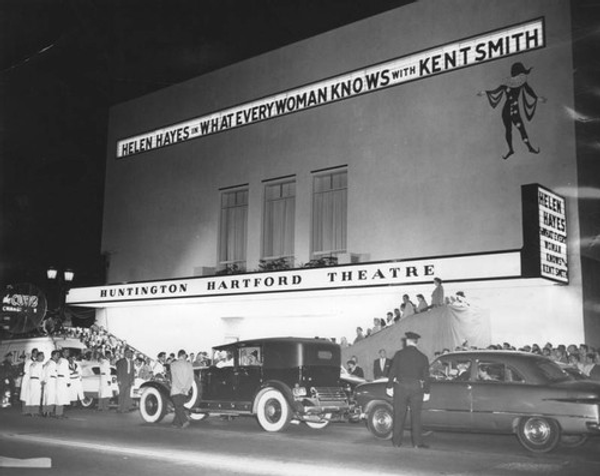
Hartford’s most significant early successes were actually in Southern California. In 1954, he purchased the Vine Street Theatre in Hollywood, poured $750,000 into its renovation, and renamed it the Huntington Hartford Theatre. It became a premier venue for legitimate stage productions in a city dominated by film.
Perhaps his most noble “failure” was the Huntington Hartford Foundation artist retreat in Pacific Palisades. Nestled in Rustic Canyon, this colony provided stipends and housing for artists, composers, and writers (including Edward Hopper and Aaron Copland). While a creative triumph, it was a financial drain that Hartford eventually shuttered in 1965 after the city of Los Angeles refused to take it over.
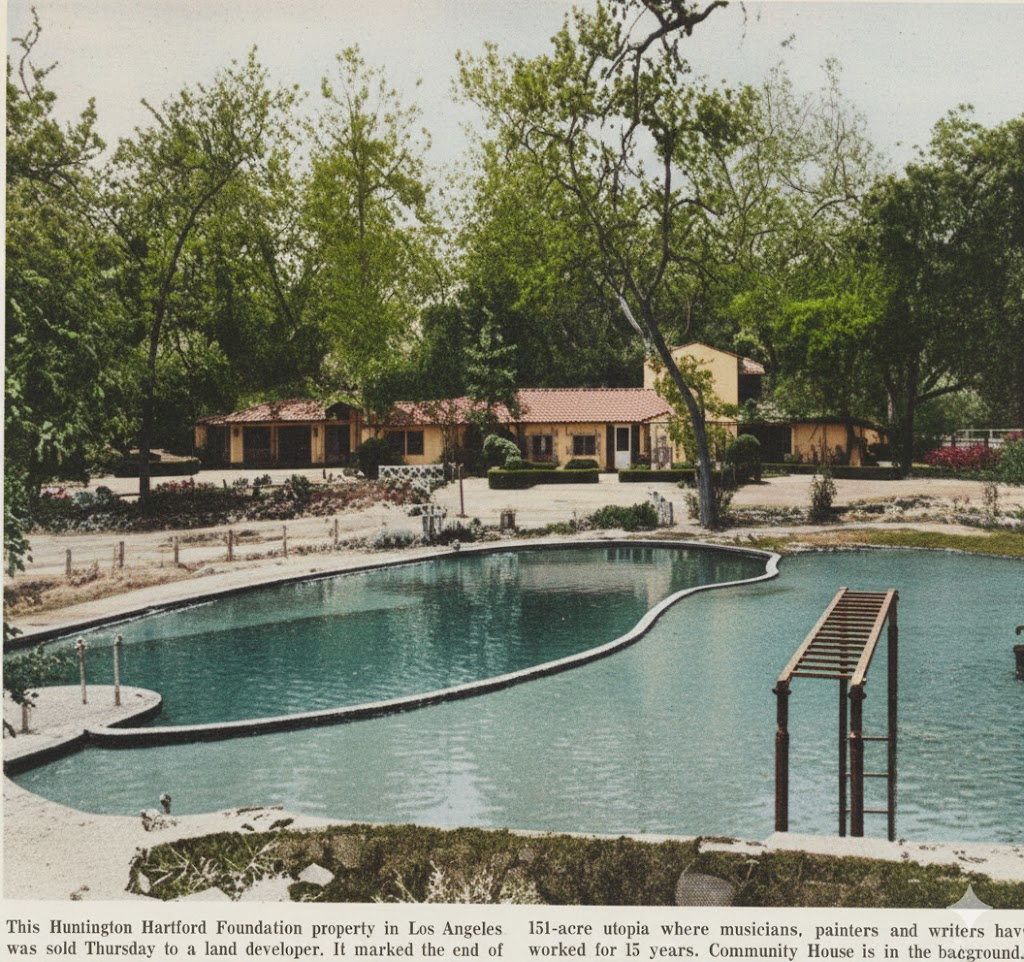
Hunt dreamed of creating an oasis in LA that would attract the local artists, actors, etc., providing them with a creative space. He went so far as to have Frank Lloyd Wright design some of the buildings, including the sports club and play resort shown here. These were never built since he began to run out of money and lose faith in the project.
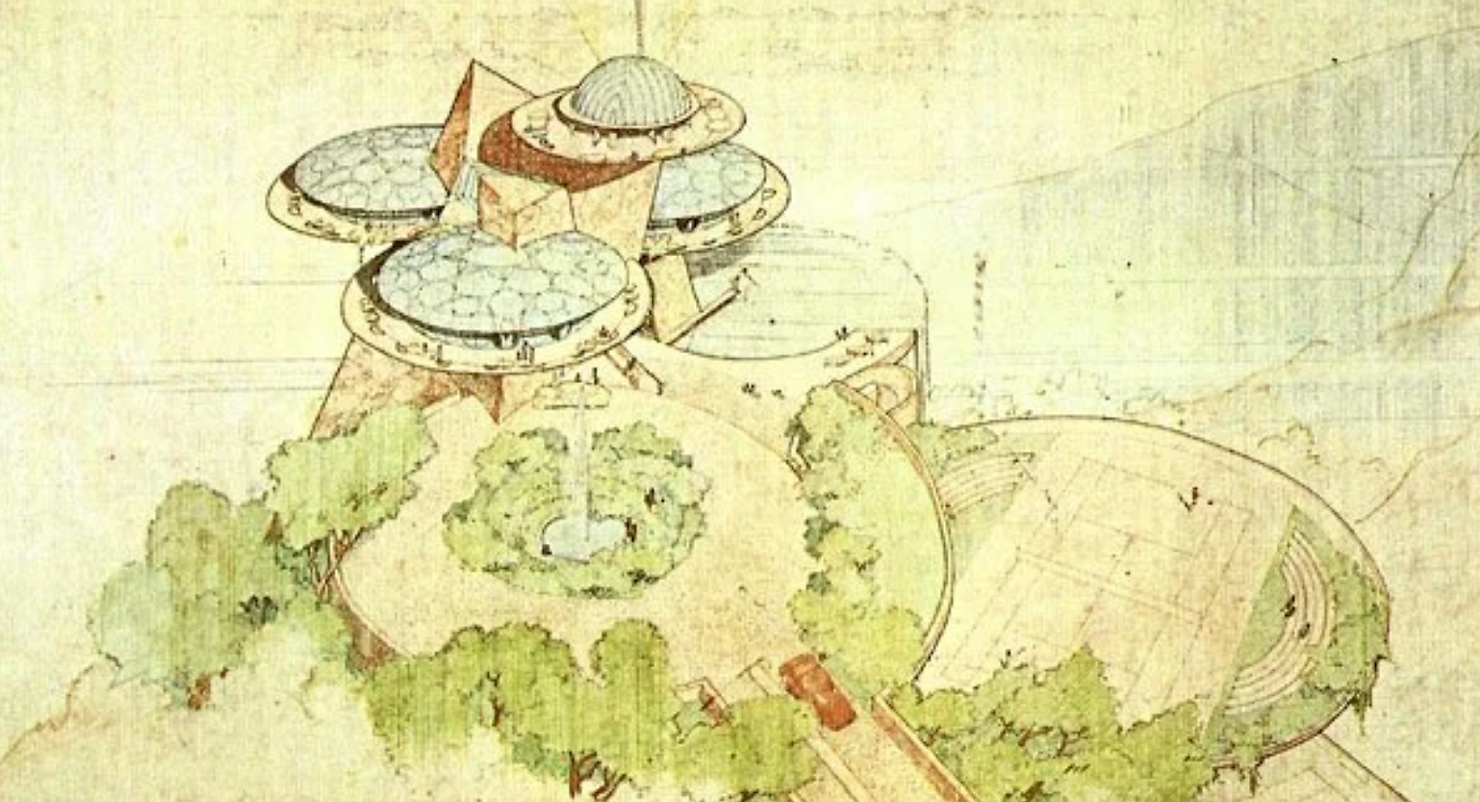
The Sports Club and Play Resort envisioned by Huntington Hartford to be built on his LA Rustic Canyon property, designed by Frank Lloyd Wright…but never built.
The 1960s: Audacious Ambitions and Real Estate
In the early 1960s, Hartford’s ambitions shifted from the stage to the soil. He purchased Hog Island in the Bahamas, renaming it Paradise Island. He spent nearly $30 million—an astronomical sum at the time—to develop an ultra-luxury resort complete with the Ocean Club and a 14th-century French cloister he had imported piece by piece from Europe.
Simultaneously, he challenged the New York art establishment by building the Gallery of Modern Art at 2 Columbus Circle.
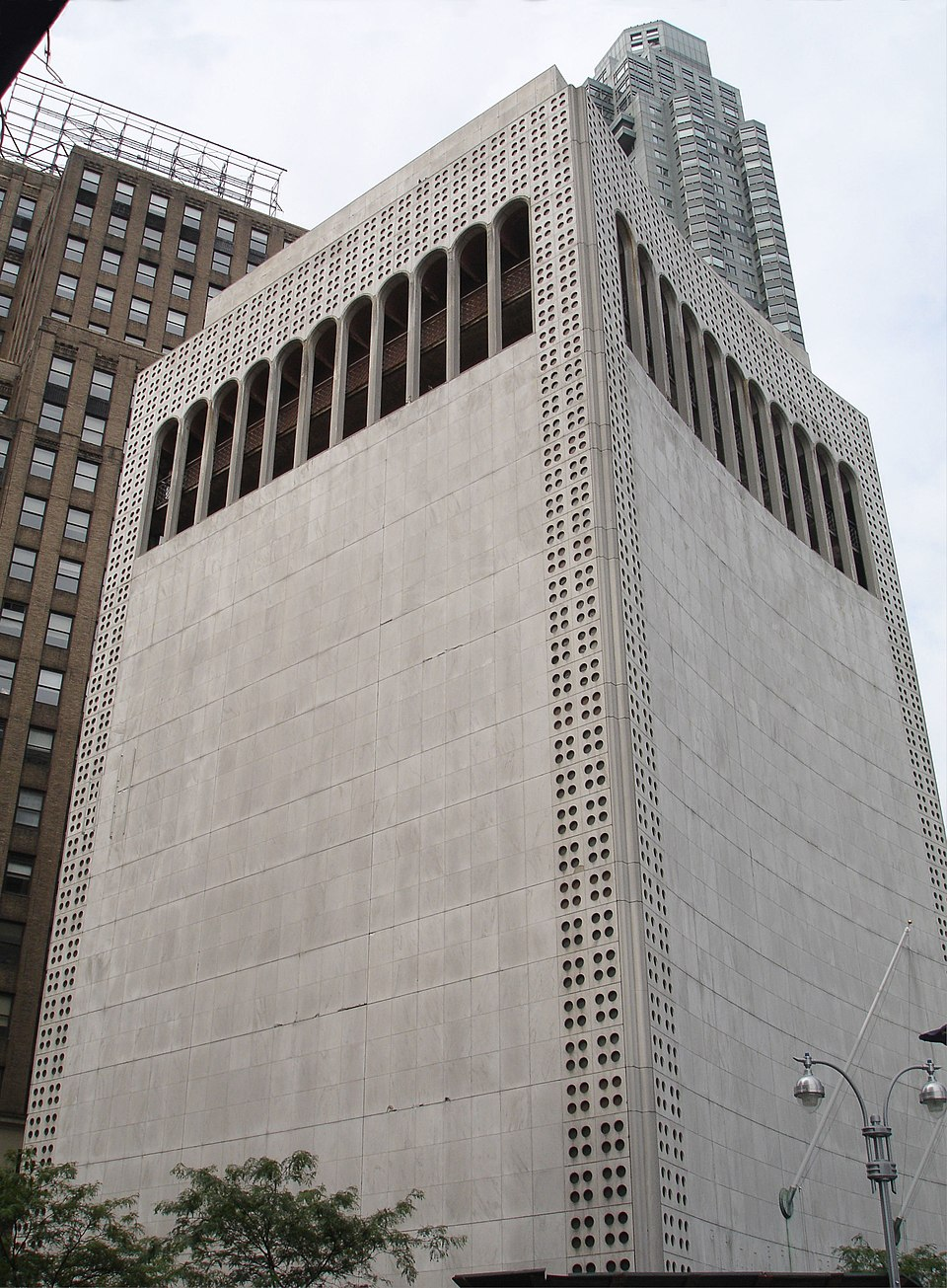
Designed by Edward Durell Stone, the “Lollipop Building” was intended to house Hartford’s collection of figurative art, which he championed as a protest against the rising tide of Abstract Expressionism.
Obstacles, Difficulties, and the L.A. Decline
By the late 1960s, Hartford’s empire began to crumble under the weight of “magnificent failures.”
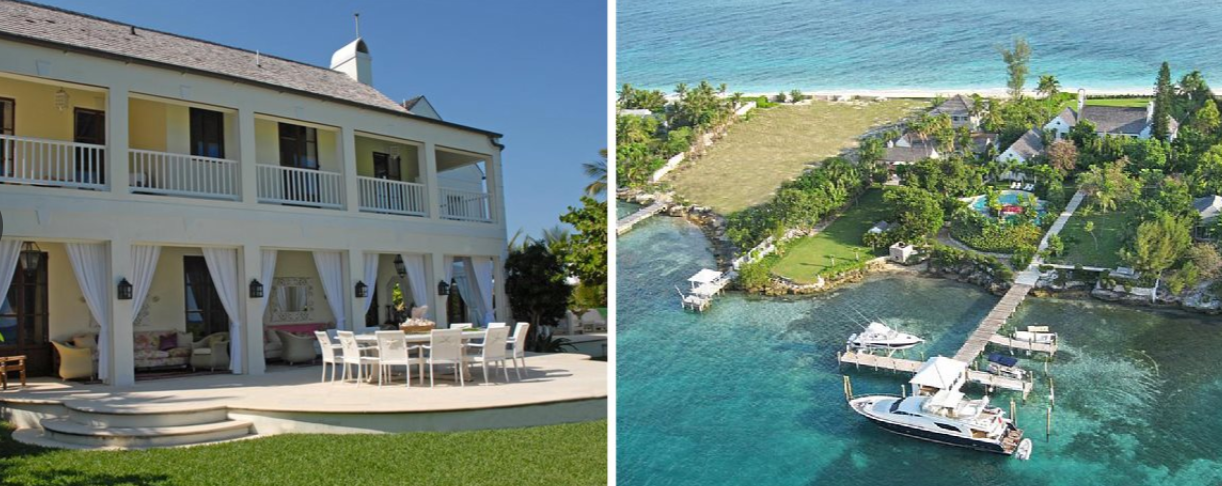
The Bahamas Debacle: Paradise Island was a financial sinkhole. Lacking a gambling license and facing political shifts in the Bahamas, Hartford was eventually forced to sell his stake at a massive loss to the Mary Carter Paint Company (which later became Resorts International). His home there was later owned by Sir Richard Branson. More information about Paradise Island can be seen by clicking HERE.
The “Show” Magazine Collapse: Hartford launched Show magazine, a sophisticated arts publication based in Hollywood and New York. Despite its high quality, it bled money and folded, further depleting his liquidity.
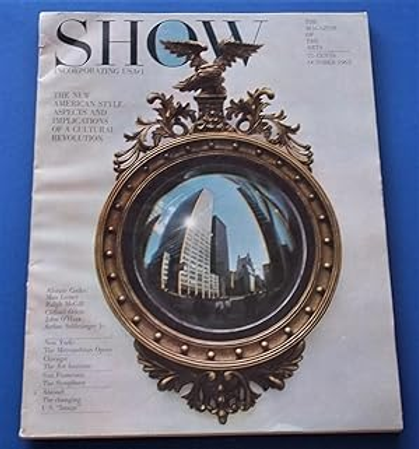
Personal Missteps: It is important to note a correction: Hartford was never married to Lillian Gish (though they were close friends and she starred in his productions). He had four high-profile, expensive divorces—most notably from Diane Brown and Maryel Eger—which, combined with his lavish lifestyle, decimated his trust funds. He was constantly shown in the press at discos and with much younger women.
By the 1970s, Hartford was frequently in the news for legal battles over his debts and his increasingly eccentric behavior, becoming a recluse in his Manhattan townhouse and later in a run-down estate in the Bahamas.
Final Years and a Complicated Legacy
Despite the bankruptcy and the loss of his Gallery of Modern Art (which is now the Museum of Arts and Design), Hartford’s impact on the cultural landscape remains undeniable.
His Los Angeles theater (now the Avalon Hollywood) remains a landmark of the city’s theatrical history. His Paradise Island vision laid the groundwork for one of the world’s most famous tourism hubs. While he died in 2008 with only a small fraction of his original billion-dollar inheritance, he succeeded in his primary goal: he was never just a “grocery boy.” He was a man who, for better or worse, spent a fortune trying to make the world more beautiful.
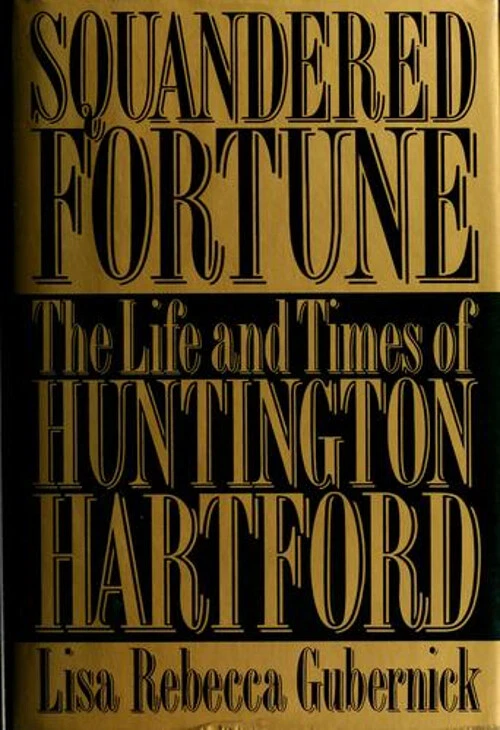
A great book by Lisa Rebecca Gubernick outlines the arc and fall of Huntington Hartford.
Huntington Hartford passed away on December 24, 2008, leaving behind a multifaceted legacy and having squandered the family fortune. His life narrative embodies ambition, creativity, and perseverance in the face of challenges. Although his ventures were not always successful, his influence on the arts and philanthropic contributions are still recognized and celebrated today.
Final Thoughts
The story of Huntington Hartford illustrates the peaks and valleys that can accompany a life driven by ambition and creativity. From his early achievements in the family business to his struggles in real estate and personal matters, Hartford’s experiences reflect the unpredictable nature of success and the lasting impact of one’s contributions to culture and society.